
USMCA Food & Beverage Trade 2026: Ground Transport, Border Inspections, Customs Brokerage, and Current Controversies Across Mexico, USA, and Canada
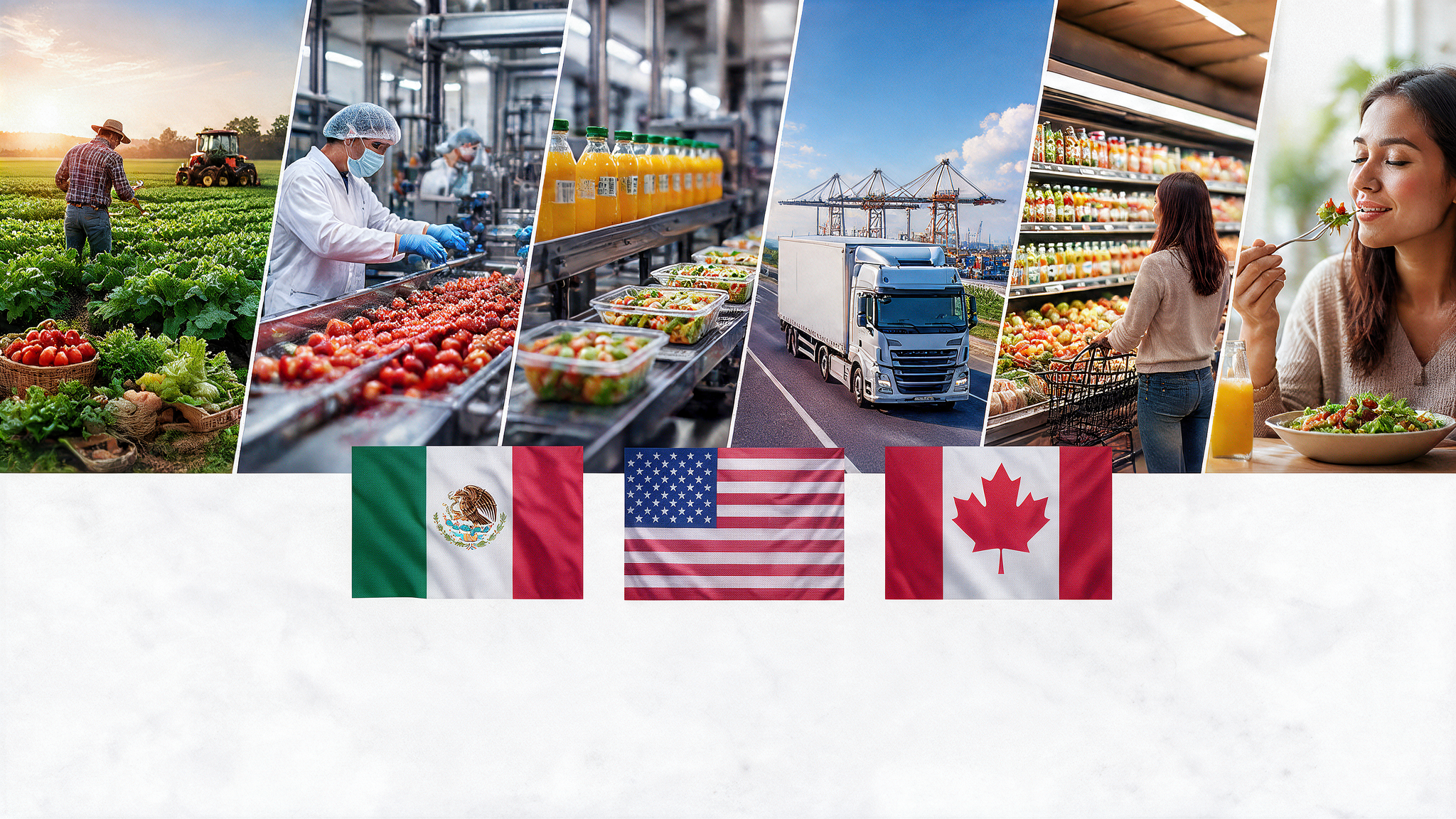
This article provides a comprehensive guide to the North American food and beverage trade through the lens of freight transport. We examine trade volumes for all three countries, the types of products each nation supplies, and the critical border inspection processes governed by agencies including the U.S. FDA and USDA, Mexico’s COFEPRIS and SAT, and Canada’s CFIA and CBSA. We also explore the essential role of customs brokers in ensuring smooth cross-border movement and the current controversies shaping the industry during the USMCA joint review that commenced on July 1, 2026—including the biotech corn dispute, Canadian dairy access, and the decision to conduct annual reviews instead of a 16-year extension.
At Mexicom Group, we specialize in cross-border food and beverage logistics, helping shippers navigate regulatory complexity and keep supply chains moving. This article reflects our commitment to providing actionable intelligence for industry professionals.
Trade Overview – The Numbers Behind North American Food & Beverage Trade
Food & Beverage Trade by the Numbers
United States
Mexico
Canada
Fresh Fruit Imports
Fresh Vegetable Imports
United States: The Agricultural Powerhouse
The United States is a dominant force in North American agricultural trade, with its USMCA partners as its most important customers. Corn remains the top U.S. agricultural export to Mexico, led by Corn Belt states including Iowa, Illinois, Kansas, and Nebraska .
Key U.S. Agricultural Exports to Mexico (2025) :
| Product Category | Significance |
|---|---|
| Corn | Top U.S. agricultural export to Mexico |
| Pork | Major export commodity |
| Dairy Products | Significant export category |
| Soybeans | Key export product |
| Poultry & Beef | Important meat exports |
U.S. exports to Canada include fresh fruits and vegetables, processed products, and pork . The agricultural sector’s dependence on Mexican and Canadian demand translates into substantial employment: soybean and corn exports alone supported over 212,516 jobs, while beef, chicken, and pork exports supported approximately 157,434 jobs (USDA, 2025) .
U.S.-Mexico Agricultural Trade Complementarity :
-
Nearly 74.9% of U.S. agricultural exports to Mexico are grains, oilseeds, meat, or related products
-
Just over 70.7% of U.S. agricultural imports from Mexico consist of vegetables, fruit, beverages, and distilled spirits
-
This complementarity reflects Mexico’s need to import grains to meet domestic demand and produce value-added products
Mexico: Growing Exporter and Import-Dependent Partner
Mexico has been the United States’ leading agricultural supplier since 2014 . In 2025, Mexican agricultural exports to all countries totaled about $45.7 billion**, while imports reached approximately **$37.5 billion .
Mexico’s agricultural exports are the country’s second largest export category after manufacturing .
Top Mexican Food Exports to the U.S. :
| Product | Key Detail |
|---|---|
| Fresh Vegetables & Fruits | Avocados, tomatoes, berries (year-round supply) |
| Beverages & Distilled Spirits | Beer, tequila, mezcal |
| Live Cattle | Valued at $1.2 billion annually |
Mexico’s Import Dependence:
Mexico faces significant import dependence, particularly for grains. Between January and May 2026, Mexico imported 19.9 million tons of grains and oilseeds, the second-highest volume ever recorded. Corn imports reached 10.2 million tons, up 8.4% year-over-year . The United States remains Mexico’s sole supplier of corn imports, making ground transportation of this commodity critical.
Canada: Grain and Pulse Supplier
Canada plays a vital role in the North American food supply chain, particularly in grains and pulses such as wheat, lentils, and peas . Under USMCA (CUSMA in Canada), these products can move tariff-free across borders when they meet rules of origin requirements.
Key Canadian Exports to the U.S. and Mexico :
-
Grains (wheat, canola)
-
Meat and dairy products
-
Pulses (lentils, peas)
Trade Volumes: U.S.-Canadian agricultural trade totaled approximately $67.5 billion in combined exports and imports in 2025 .
The Fresh Produce Dependency
The U.S. relies heavily on its USMCA partners for year-round availability of fresh fruits and vegetables. In 2023 :
-
Mexico and Canada supplied 51% and 2%, respectively, of U.S. fresh fruit imports
-
Mexico and Canada supplied 69% and 20%, respectively, of fresh vegetable imports
Since 1981, imports have expanded almost without interruption. By 2023, nearly 60% of fresh fruit and 35% of fresh vegetable availability in the U.S. came from imports .
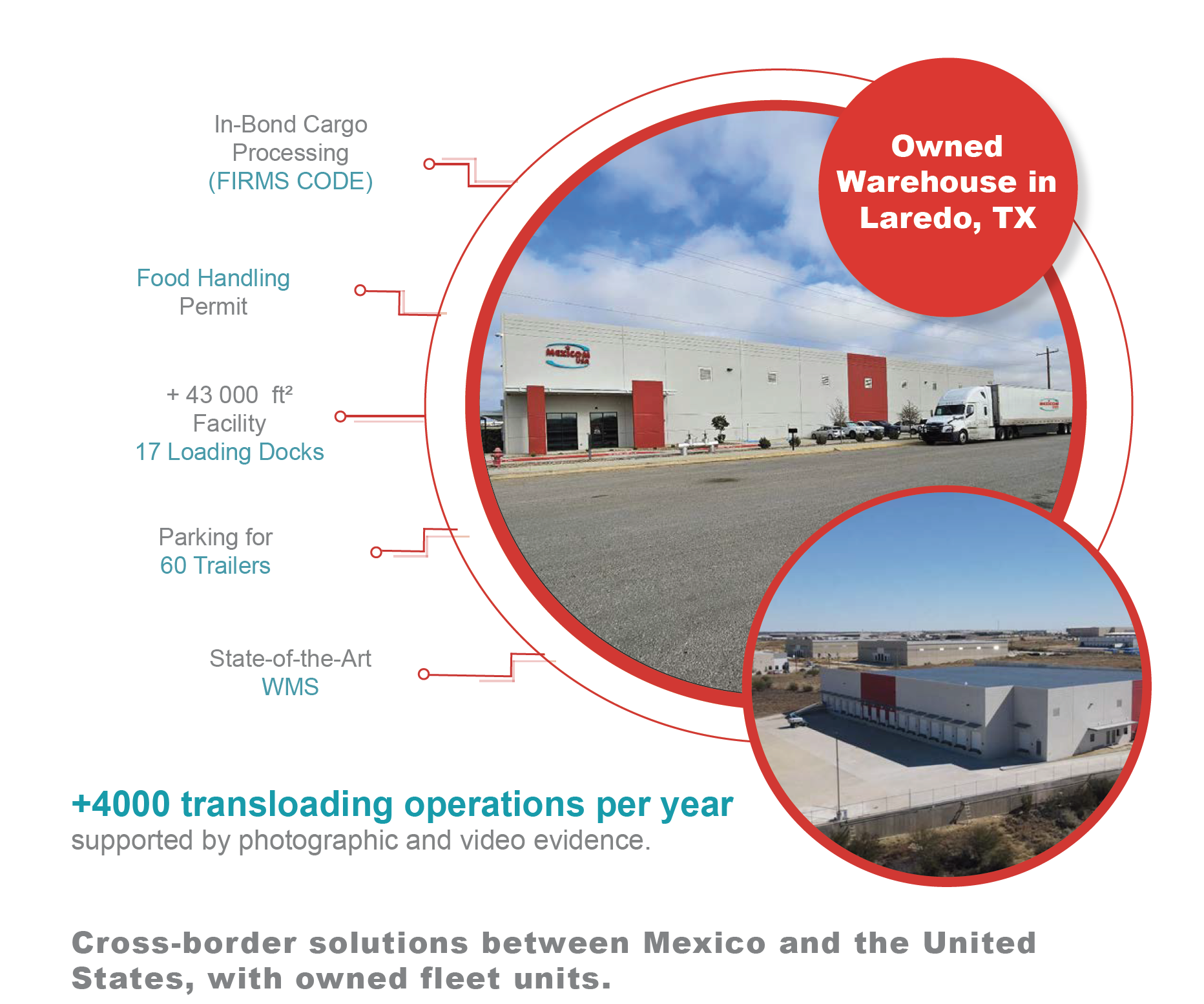
Strategically located in Laredo, our warehouse keeps your cross-border freight moving.
Contact us today
info@mexicomusa.com
Tel. +1 (956) 516-7201
Regulatory Framework: Key Regulations, Inspection Agencies, and Processes
Key Regulations and Agencies
United States
-
FDA (Food and Drug Administration): Regulates food safety, pharmaceuticals, and cosmetics. Importers must comply with the Foreign Supplier Verification Program (FSVP) under FSMA
-
USDA APHIS (Animal and Plant Health Inspection Service): Regulates imports of plants, animals, and agricultural products
-
USDA FSIS (Food Safety and Inspection Service): Inspects meat, poultry, and egg products
-
CBP (Customs and Border Protection): Manages customs clearance at the border
-
TTB (Alcohol and Tobacco Tax and Trade Bureau): Certifies imports of beer, wine, and spirits
Mexico
-
COFEPRIS (Federal Commission for the Protection against Sanitary Risks): Regulates food safety and sanitary authorizations
-
ANAM (National Customs Agency of Mexico): Manages customs clearance
-
SIAP (Agricultural and Fisheries Information Service): Provides agricultural statistics and oversight
Canada
-
CFIA (Canadian Food Inspection Agency): Enforces food safety standards at the border and beyond
-
Health Canada: Sets food safety standards and regulations
-
CBSA (Canada Border Services Agency): Manages customs clearance
Inspection Processes by Country
| Process Element | 🇺🇸 USA | 🇲🇽 Mexico | 🇨🇦 Canada |
|---|---|---|---|
| Health Regulator | FDA | COFEPRIS | CFIA |
| Customs Agency | CBP | SAT | CBSA |
| Agriculture Agency | USDA APHIS/FSIS | SENASICA | CFIA |
| Pre-Arrival Notice | FDA Prior Notice (2 hrs for trucks) |
Import Authorization | AIRS Documentation |
| Physical Inspection Rate | Risk-based | Random (Green/Red Light) |
5–8% manual |
| Common Issue | Missing Prior Notice | Incorrect COFEPRIS | No SFC License |
United States: Multi-Agency Inspection Framework
The U.S. border inspection process for food products involves coordination among Customs and Border Protection (CBP), the Food and Drug Administration (FDA), and the Department of Agriculture (USDA).
U.S. Customs Examination Levels
| Examination Type | Focus | Impact |
|---|---|---|
| 1A – Document Review | Paperwork verification | Minimal delay (hours) |
| 4A – USMCA Verification | Origin certification, production records | Potential tariff loss (1-2 days) |
| 7H – X-Ray Scan | Non-invasive container screening | Moderate delay |
| 1H – Physical Inspection | Labels, certification, compliance | Significant delay |
| 2H – Agriculture Inspection | Quarantine, pests, health compliance | Major delay; possible rejection |
| 5H – Enhanced Review | Highest risk; deep investigation | Most severe; increased in 2026 |
USDA-APHIS Inspections:
For plant and animal products, USDA APHIS requires import permits and may conduct physical inspections. If data discrepancies are found or quarantine pests are detected, merchandise is retained and samples sent to laboratories for identification .
FDA Detention Process:
If FDA identifies compliance issues, a Detention Without Physical Examination (DWPE) may be issued, automatically detaining all future shipments from a supplier until compliance is proven. Importers have 10-20 business days to submit evidence.
Mexico: COFEPRIS and SAT Coordination
Mexico’s border inspection process involves the Federal Commission for the Protection against Sanitary Risks (COFEPRIS) for health regulation and the National Customs Agency of Mexico (SAT) for customs clearance.
Inspection Process
Mexico operates a dual-track system:
-
Documentary Review: All shipments undergo initial document verification
-
Physical Inspection: Random inspections conducted with two outcomes:
-
Green Light: Inspection waived
-
Red Light: Direct physical inspection required
-
If problems are detected during inspection, the shipment is immediately blocked for re-export or destruction.
COFEPRIS Registration is mandatory for food and beverage products. The approval process can take months and requires:
-
Complete ingredient composition
-
Physical and microbiological specifications
-
Manufacturing process documentation
-
Label samples
-
Safety assessments
-
GMP documentation
Labeling Requirements (NOM standards):
-
Spanish language labeling (English may appear alongside)
-
Mandatory product name, ingredients, nutritional information, calorie content
-
Allergen warnings
-
“Nueva Etiqueta” (Stop Sign Labels) for specific products
Canada: CFIA and CBSA Coordination
Canada’s border inspection framework involves the Canadian Food Inspection Agency (CFIA) and the Canada Border Services Agency (CBSA).
Pre-Import Requirements (Mandatory BEFORE Arrival)
-
Valid Safe Food for Canadians (SFC) License: Issued for the activity “Importing Food” and specific commodity categories. Expanding product lines without confirming license coverage is a common failure point .
-
Preventive Control Plan (PCP): A documented system demonstrating imported food is safe, suitable, and meets Canadian requirements.
-
Compliant Labeling: Bilingual (English/French) Nutrition Facts standards.
Note: CFIA conducts manual inspections on only 5-8% of shipments; the rest are automated. However, a shipment can clear CBSA and still be held by CFIA .
Transportation and Logistics for Ground Freight
The Logistics Workflow
A typical ground transport shipment of food products follows this sequence:
-
Pre-shipment preparation: Documentation compiled, regulatory requirements verified
-
Truck transport to border crossing: Perishables require temperature-controlled trailers and strict timing
-
Customs clearance: Electronic filings transmitted; shipments may be selected for inspection
-
Cross-border movement: Once cleared, goods proceed to final destination
Time is the critical factor for food shipments—particularly perishables like fresh produce. A delay at the border can mean spoiled goods and significant financial losses.
Programs Expediting Ground Freight
FAST (Free and Secure Trade) Program :
The FAST program is a joint US-Canada trusted trader initiative that provides expedited border processing for pre-approved carriers, importers, and drivers. FAST-approved shipments typically clear the border significantly faster than standard processing.
To qualify, carriers need :
-
C-TPAT membership (U.S.) or PIP membership (Canada)
-
FAST-enrolled drivers with valid FAST cards
-
Pre-approved importers and goods
“For high-volume cross-border fleets, FAST enrollment is almost essential. The time savings compound quickly—a 30-minute reduction in border wait time per crossing, multiplied across hundreds of crossings per year, translates to thousands of hours of recovered driving time.”
Cabotage Rules :
Both the U.S. and Canada prohibit foreign carriers from hauling domestic freight within their borders. A Canadian carrier can bring a loaded trailer from Toronto to Chicago, but cannot pick up a load in Chicago and deliver it to Detroit. Violations carry severe penalties, including fines, vehicle seizure, and potential ban from cross-border operations.
IFTA and IRP Compliance :
Cross-border fleets must maintain IFTA credentials covering both U.S. states and Canadian provinces, file quarterly IFTA returns, hold IRP registrations, and track fuel purchases by jurisdiction for tax credit calculations.
Related articles on Transportation and Logistics for Ground Freight across Mexico, the U.S. and Canada
-
The ultimate guide shipping freight from the Midwest to Mexico
Are you thinking about shipping freight to Mexico? Is it going to be your first time shipping freight from the Midwest in the United States to Mexico? Do you have experience shipping freight to Mexico but you want to understand better the process and diversify your providers? You are in the right place. Mexicom logistics […]
-
The beginner’s Guide on LTL: shipping from the US and Canada to Mexico
We have prepared this guide with the most essential information about the LTL transport service. If you are getting started in the world of LTL transport between the United States and Canada to Mexico, this guide will be very useful for you. Do not forget to share and comment, we love answering our reader’s questions. […]
-
The ultimate guide shipping freight to Mexico from the US and Canada
Are you thinking about shipping freight to Mexico? Is it going to be your first time shipping freight to Mexico from the US or Canada? Do you have experience shipping freight to Mexico but you want to understand better the process? Do you want to know how the process of shipping freight to Mexico works […]

The Role of Customs Brokers
United States: The Entry Filer and Compliance Partner
In the U.S., customs brokers are licensed professionals acting as the direct interface between importers and CBP. Their responsibilities include:
-
Filing electronic entries through CBP’s Automated Commercial Environment (ACE)
-
Transmitting FDA Prior Notice (mandatory 2 hours before truck arrival)
-
Determining USMCA eligibility and ensuring proper origin documentation
-
Paying duties to the government on behalf of clients
Accuracy is paramount—transmitting incorrect entry data can increase FDA scrutiny on future shipments .
Mexico: The Importer’s Registration Partner
Mexico’s customs brokers support importers by:
-
Ensuring importer registration in SAT’s Importers Registry
-
Coordinating sanitary authorizations (SENASICA for animal/plant products; COFEPRIS for processed foods)
-
Submitting the Pedimento de importación
-
Managing origin certification for USMCA tariff preference
Communication with the importer is essential, as importers often receive early notice of regulatory updates .
Canada: The PGA Integration Partner
Canadian brokers integrate with multiple Participating Government Agencies (PGAs) including CFIA, Health Canada, and others . Responsibilities include:
-
Verifying SFC license validity before shipment arrival
-
Transmitting required information for CFIA-regulated products
-
Alerting importers when additional documentation is needed
Key point: A broker’s system is directly connected to CBSA; the entry will not be accepted until all PGA requirements are satisfied. The broker needs to know: product type, end use, packaging details, ingredient list, and country of origin.
USMCA Origin Certification
To qualify for USMCA’s preferential tariff treatment, agricultural products must meet rules of origin. For grains or pulses, one avenue is being “wholly obtained or produced entirely in the territory of Canada, the U.S., or Mexico”—meaning they are “grown, cultivated, harvested, picked, or gathered” within the region .
Related articles on Customs Brokerage for Ground Freight across Mexico, the U.S. and Canada
Crossing borders shouldn’t be complicated. Mexicom provides reliable customs brokerage services to streamline your imports and exports to and from Canada.

Current USMCA Trade Disputes in the Food & Beverage Sector
USMCA Food Trade Disputes
U.S. vs. Canada
Dairy & Alcohol Tariff WarU.S. vs. Mexico
Biotech Corn & Cheese NamesDispute Summary
1. U.S.–Canada Dairy and Alcohol Tariff War
The most intense flashpoint is a rapid escalation of tariffs between the U.S. and Canada.
U.S. Section 338 Tariffs: On August 19, 2026, the U.S. imposed a 50% tariff on Canadian dairy and alcoholic beverage products. Washington justified this aggressive measure by citing Canada’s rigid Supply Management system, its restrictive administration of Dairy Tariff-Rate Quotas (TRQs), and instances where U.S. alcohol was allegedly stripped from Canadian retail shelves . The tariffs cover approximately $20 billion of Canadian goods and have no USMCA exemption .
Canadian Retaliation: Canada struck back with a massive multi-billion-dollar retaliatory package effective September 8, 2026, including 15–50% tariffs on C$27.6 billion (~$19.9 billion) of U.S. goods across 874 tariff lines . This directly impacts U.S. exports of beer, wine, spirits, orange juice, coffee, and peanut butter. Notably, Canada exempted U.S. seafood to prevent breaking highly integrated supply chains .
2. Dairy Market Access & TRQ Disputes
Beyond the immediate tariff war, U.S. dairy bodies like the National Milk Producers Federation (NMPF) and the U.S. Dairy Export Council (USDEC) are using the joint review to address structural grievances :
-
Underfilled Quotas: U.S. groups argue that Canada’s domestic allocation of quotas creates “paper-only” access. For example, less than 10% of the negotiated Canadian yogurt quota was filled due to bureaucratic hurdles .
-
Dairy Protein Dumping: The U.S. is pushing to stop Canada’s practice of offloading surplus non-fat milk solids and dairy proteins onto global markets, which undercuts U.S. pricing .
3. Biotechnology & GE Corn (U.S. vs. Mexico)
Mexico’s domestic decree to phase out genetically engineered corn for human consumption remains an unresolved battleground. A USMCA dispute panel ruled in favor of the U.S. on all seven claims, finding that Mexico’s proposed ban lacked scientific basis . Mexico defends its policy under “food sovereignty” and biodiversity, while U.S. agricultural groups demand a strict, science-based biotechnology approval framework .
4. Common Food Names (U.S. vs. Mexico)
U.S. food and beverage manufacturers are utilizing the 2026 review to force Mexico to implement commitments regarding common cheese names. In May 2026, Mexico signed a trade agreement with the EU agreeing to protect European geographical indications (GIs) for cheeses like “parmesan” and “feta” . This threatens U.S. producers’ ability to use these generic terms in the Mexican market, where the U.S. supplies 87% of all cheese imports .
5. Seasonal Produce Friction
U.S. specialty crop growers are demanding “seasonal trade remedies” to protect domestic growers from surges of Mexican fresh produce during peak U.S. harvesting seasons . In August 2026, the U.S. Department of Commerce issued a preliminary anti-dumping determination against Mexican winter strawberry imports, a move the Mexican National Agricultural Council (CNA) called arbitrary and contrary to USMCA provisions . The CNA warned this sets a negative precedent that could affect nearly 5,000 strawberry producers and 151,000 workers in Mexico .
Strategically located in Laredo, our warehouse keeps your cross-border freight moving.
Contact us today
info@mexicomusa.com
Tel. +1 (956) 516-7201