
Chemical Supply Chains Across North America: A Ground Freight Guide for Mexico, the U.S., and Canada
North America’s chemical industry operates as a deeply integrated network. A single molecule of polyethylene may be produced in Texas from Canadian natural gas liquids, converted into resin in Alberta, and shipped by truck to a packaging manufacturer in Querétaro—crossing two international borders along the way. For exporters, importers, and logistics decision-makers, understanding how this network functions—and how it is regulated—is not optional. It is operational infrastructure.
This article examines the ground freight dimension of trilateral chemical trade: the trade flows, the regulatory frameworks in each country, the documentation that moves with the cargo, and the policy questions now shaping the industry’s future. It is written for those who need to make sourcing, compliance, and carrier decisions with confidence.
North America’s Chemical Industry Runs on Cross-Border Trade
Chemical manufacturing is one of North America’s three largest productive sectors, with a supply chain deeply integrated across the U.S., Mexico and Canada.
Three Markets. One Integrated Supply Chain.
2025 chemical market revenues
Mexico’s Chemical Trade Is Highly Integrated
Share of trade connected to the USMCA region
Polyethylene Signals a Shift in Freight Demand
Mexico and Canada’s share of total U.S. polyethylene exports
North-south chemical freight remains substantial, but its composition and directional balance are shifting.
Chemicals Power the Broader Industrial Base
Most chemical trade is an industrial input rather than a final product.
of chemical products traded within North America
are inputs for:
Chemical freight is an industrial dependency — not an isolated commodity flow.
When hazmat trucking capacity is disrupted, the impact can extend beyond chemical manufacturers to automotive, electronics, appliance and pharmaceutical production across North America.
1. The Trade Landscape: Chemical Flows Between Mexico, the U.S., and Canada
Chemical manufacturing is one of North America’s three largest productive sectors, with trilateral chemical trade exceeding $60 billion annually** since USMCA entered into force—triple the volume under the previous NAFTA framework. Mexico’s chemical industry alone conducts more than **800,000 cross-border transactions per year**, with external trade exceeding **$48 billion.
The trade is not evenly distributed. U.S. chemical market revenues reached $650.4 billion in 2025**, compared with **$77.4 billion in Mexico and $47.6 billion in Canada. But the smaller markets are deeply dependent on cross-border flows. For Mexico, 67.5% of chemical imports originate within the USMCA region, and 61.8% of chemical exports are destined for the U.S. or Canada. Mexico’s petrochemical sector is particularly integrated: 71% of petrochemical imports and 59% of petrochemical exports flow through USMCA channels.
Polyethylene offers a useful proxy for ground freight demand. Mexico and Canada together absorbed 19% of total U.S. polyethylene exports in 2025, down from 28% in 2021—a decline that reflects both expanded U.S. export capacity to other markets and softer North American demand. For ground carriers, this means that while the absolute volume of north-south chemical freight remains substantial, the composition and directional balance of that freight is shifting.
Nearly 95% of chemical products traded within North America are inputs for automotive, electronics, appliance, and pharmaceutical manufacturing. This makes chemical logistics a strategic dependency for the broader industrial base: a disruption in hazmat trucking capacity does not stay contained within the chemical sector.
Three Countries. One Cross-Border Challenge.
Hazardous materials regulations across North America follow a similar classification philosophy — but compliance requirements differ by country.
United States
49 CFR Parts 171–180Administered by PHMSA, with enforcement support from FMCSA. Covers classification, documentation, labeling, packaging and mode-specific requirements.
Mexico
NOM StandardsHazardous materials transportation is governed by mandatory NOM standards issued through SICT, including requirements for transport documents, emergency information and specific hazard classes.
Canada
TDG RegulationsTransport Canada regulates classification, documentation, safety marks and containment — with specific exemptions for certain limited or smaller quantities.
UN classification principles create a common foundation.
But packing groups, documentation, exemptions and other compliance requirements can differ by country.
A shipment compliant in one country is not automatically compliant in another. Shippers must verify the classification and documentation requirements for each jurisdiction.
Cross-border hazmat compliance requires more than a single rulebook.
The right classification, documentation and carrier requirements must travel with the shipment across borders.
2. Regulatory Architecture: Three Countries, Three Frameworks
Hazardous materials transportation in North America is governed by three distinct but functionally aligned regulatory systems. The classification logic is harmonized through the United Nations Model Regulations, but the compliance mechanics differ in ways that matter for cross-border operations.
United States: 49 CFR Parts 171–180
The U.S. framework is administered by the Pipeline and Hazardous Materials Safety Administration (PHMSA) under the Department of Transportation, with enforcement support from the Federal Motor Carrier Safety Administration (FMCSA). The regulatory text is organized as follows:
| Part | Subject |
|---|---|
| 171 | General definitions and applicability |
| 172 | Hazard communication (labels, placards, shipping papers, markings) |
| 173 | Packaging requirements by hazard class |
| 174–177 | Mode-specific rules (rail, air, highway, vessel) |
| 180 | Qualification, maintenance, and testing of packagings |
A material is regulated as hazardous if it appears in the DOT Hazardous Materials Table at 49 CFR 172.101, or if it meets the hazard class definitions in Part 173. PHMSA has also adopted several international consensus standards to facilitate cross-border operations, including mutual recognition of Canadian TDG-equivalent certifications for pressure vessels used in transport.
Mexico: NOM Standards Under SICT
Mexico’s ground transport of hazardous materials is regulated through Normas Oficiales Mexicanas (NOMs) issued by the Secretaría de Infraestructura, Comunicaciones y Transportes (SICT). These standards carry mandatory legal force under Mexico’s General Law of Ecological Balance and Environmental Protection.
The most operationally significant NOMs for chemical carriers include:
-
NOM-043-SCT-2-2003 (superseded by NOM-043-SCT-SEMAR-ARTF-2023): governs the transport document for hazardous substances and wastes, specifying the information that must accompany every shipment.
-
NOM-011-SCT-2-2003: conditions for transporting hazardous materials in limited quantities.
-
NOM-005-SCT-2008: emergency information requirements for hazardous materials transport.
-
NOM-028-SCT2/1998: special provisions for Class 3 flammable liquids.
The 2023 revision of NOM-043 aligned Mexico’s transport document requirements more closely with the UN Model Regulations, but the transition period for full compliance required careful attention from shippers and carriers.
Canada: TDG Regulations
Canada’s Transportation of Dangerous Goods (TDG) Regulations, administered by Transport Canada, apply to road, rail, and domestic marine transport. The regulations are structured in parts covering interpretation and general provisions (Part 1), classification (Part 2), documentation (Part 3), safety marks (Part 4), and means of containment (Part 5), among others.
Canada’s TDG regime includes several exemptions that are unique in North America and frequently relevant to chemical shippers:
-
150 kg gross mass exemption (Section 1.15)
-
500 kg gross mass exemption (Section 1.16)
-
Limited quantities exemption (Section 1.17)
-
Excepted quantities exemption (Section 1.17.1)
These exemptions can reduce documentation and safety-mark obligations for smaller shipments, but they carry specific conditions—including prohibitions on certain high-risk classes—that shippers must verify before relying on them.
Cross-Border Alignment and Its Limits
The three systems are “closely aligned” in classification philosophy, but they are not interchangeable. A material classified as a Class 3 flammable liquid under 49 CFR may carry a different packing group or subsidiary risk under TDG, depending on the specific test data and the consignor’s classification determination. Under Canadian TDG, the consignor is legally responsible for classification, and this responsibility cannot be delegated to the carrier. In practice, this means that a Mexican exporter shipping to Canada must ensure that its classification documentation satisfies both U.S. HMR and Canadian TDG requirements—often through a bridge document that maps the relevant data fields across both systems.
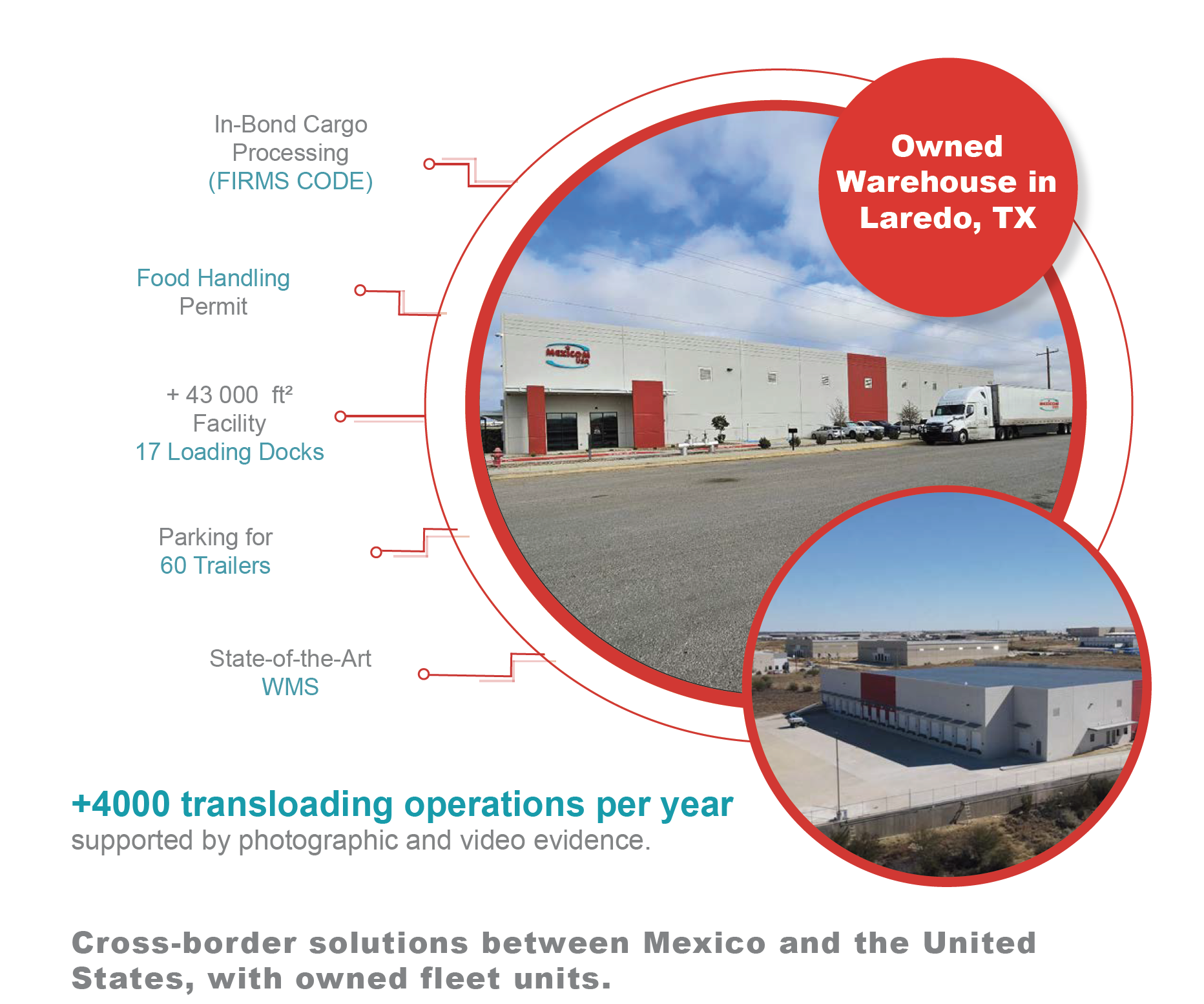
Strategically located in Laredo, our warehouse keeps your cross-border freight moving.
Contact us today
info@mexicomusa.com
Tel. +1 (956) 516-7201
3. Hazardous Materials Classification: The Nine Classes and What They Mean for Ground Freight
All three countries use the same nine-class structure derived from the UN Model Regulations. For ground freight planning, the practical significance of classification lies in packaging selection, placarding thresholds, driver endorsement requirements, and routing restrictions.
Hazardous Materials: 9 Classes
Understanding the main hazardous materials classifications and the considerations involved in ground transportation.
Class 1 Explosives
Requires specialized packaging, route restrictions, and in many cases advance notification to authorities. U.S. HM/permit requirements may apply.
Class 2 Gases
Includes flammable, non-flammable, and toxic gases. Cylinder integrity documentation is important; toxic gases may require additional emergency response planning.
Class 3 Flammable Liquids
A common hazardous freight class. Packing Group I materials require stricter packaging and may involve additional driver requirements.
Class 4 Flammable Solids
Includes spontaneously combustible and water-reactive materials. Water-reactive shipments require specific weather and road-condition planning.
Class 5 Oxidizers
Includes oxidizers and organic peroxides. Some organic peroxides require temperature control, and segregation from incompatible materials may be necessary.
Class 6 Toxic & Infectious
Covers toxic and infectious substances. Poisonous-by-inhalation materials can trigger additional regulatory requirements.
Class 7 Radioactive Materials
Radioactive materials are subject to specialized regulatory requirements and separate regulatory authorities in the United States and Canada.
Class 8 Corrosives
Often shipped in lined or specialized tank trailers. Compatibility with previous cargo and proper tank cleaning are critical considerations.
Class 9 Miscellaneous
Includes environmentally hazardous substances and lithium batteries. Classification thresholds and requirements vary by jurisdiction.
A critical operational point: many chemical products carry more than one hazard class. Under Canadian TDG, the consignor must determine the primary class—the one presenting the greatest danger—and identify any subsidiary classes that must also be communicated on labels and placards. For example, a corrosive liquid with flammable properties may be Class 8 primary with a Class 3 subsidiary, requiring both placards on the vehicle. Misclassifying the primary/subclass relationship is one of the most common causes of border inspection delays and regulatory violations.
4. Documentation: What Moves With the Cargo
The documentation package for a cross-border hazmat shipment is the carrier’s first line of compliance defense—and often the point at which delays begin.
The Transport Document (Shipping Paper)
Every hazardous materials shipment must be accompanied by a transport document containing, at minimum:
-
UN/NA identification number (four digits)
-
Proper shipping name (as listed in the applicable Hazardous Materials Table or TDG Schedule 1)
-
Hazard class (primary and any subsidiary)
-
Packing group (I, II, or III, where applicable)
-
Consignor certification statement
-
24-hour emergency response telephone number
In Mexico, NOM-043-SCT-SEMAR-ARTF-2023 specifies the required format and content of this document, including declarations by the expedidor regarding classification and emergency information. In the United States, the shipping paper requirements are set out at 49 CFR 172.200–172.205, and the emergency response number requirement at 49 CFR 172.604.
Safety Data Sheets (SDS)
The SDS is not a transport document, but it is the primary source document from which transport classification data is drawn. Under OSHA’s Hazard Communication Standard (29 CFR 1910.1200), Section 1 of the SDS must include a U.S.-based emergency phone number and company contact. For the first U.S. recipient of a foreign shipment, the recipient is responsible for issuing a compliant SDS if the incoming document does not satisfy U.S. requirements.
A common misconception: the SDS is not a substitute for the transport document. PHMSA has stated explicitly that it “does not verify or certify transportation information in an SDS,” and that an SDS “may or may not accurately reflect the appropriate hazardous materials information for purposes of the HMR”. Shippers should treat the SDS Section 14 (Transport Information) as a reference point, not as a compliant shipping paper.
Electronic Pre-Filing (ACE eManifest)
For truck cargo entering the United States, CBP requires electronic pre-filing through the Automated Commercial Environment (ACE) eManifest system before arrival at the border. The Pre-Arrival Processing System (PAPS) links the electronic filing to the specific truck and shipment, allowing CBP officers to make admissibility decisions before the vehicle reaches the port.
For hazardous materials shipments, the pre-filing must include the international hazard code in addition to standard commercial data. This is a field that is frequently omitted by carriers unfamiliar with hazmat pre-filing, and its absence can trigger a border hold even when all physical documentation is correct.
Driver Credentials for Hazmat
Drivers transporting placarded hazmat loads into or within the United States must hold a Hazardous Materials Endorsement (HME) on their commercial driver’s license. For drivers licensed in Canada or Mexico, the requirement is a background check equivalent to the U.S. HME security threat assessment—a standard set out at 49 CFR 1572.201. This means that a Canadian or Mexican driver cannot simply cross the border with a hazmat load based on home-country credentials alone; the security clearance must be recognized by U.S. authorities. TSA processing for the HME assessment typically requires 30 days, and the approval letter must be used within six months or the process must be restarted.
Hazmat Documentation: 4 Things That Matter
The right documents and credentials can make the difference between a smooth border crossing and a costly delay.
Transport Document
Must include the UN/NA number, proper shipping name, hazard class, packing group and emergency contact.
SDS ≠ Shipping Paper
The SDS provides classification information, but it does not replace the required transport document.
ACE eManifest
U.S.-bound truck cargo requires electronic pre-filing. Hazmat shipments must include the international hazard code.
Driver Credentials
U.S. placarded hazmat loads require appropriate HME security clearance or recognized equivalent.
Correct cargo + correct paperwork + qualified driver = fewer border surprises.
5. Cross-Border Operations: Route, Inspection, and Emergency Response
Border Crossing Procedures
For hazmat truck traffic between the U.S. and Canada, the primary documentation chain is the ACE eManifest (U.S. side) and the ACI eManifest (Canada Border Services Agency side). For U.S.–Mexico crossings, the equivalent mechanisms are ACE eManifest and the Mexican Documento de Transporte under NOM-043.
At the physical border, hazmat loads are subject to enhanced inspection protocols. Vehicle Inspection Connection (VIC) certificates for emissions compliance may be required for Mexican carriers operating into the U.S., and vehicles must meet brake and ABS specifications under NOM-012-SCT-2-2017 for Mexican-side compliance. Drivers must also carry employment agreements or service certificates linking them to the carrier named on the operating permit.
Emergency Response Information
Every hazmat shipment must carry emergency response information in a physical, legible English-language document, as required by 49 CFR 172.602. This document must include the hazards of the material, immediate first-aid measures, and firefighting procedures. The 24/7 emergency telephone number must be answered by someone with immediate access to product-specific information—voicemail or callback systems are not acceptable.
For cross-border shipments, this creates a particular challenge: a U.S.-based emergency number is required for the U.S. leg, but the same number must also be reachable during the Canadian or Mexican legs. Many carriers solve this by subscribing to a third-party emergency response service (such as CHEMTREC) that provides 24/7 coverage across North America and can be listed on both the shipping paper and the SDS.
Hazmat Border Crossing What Happens at the Border?
A successful crossing starts before the truck reaches the border.
Pre-File
eManifest
U.S. ACE + Canada ACI
Mexico: ACE + NOM-043
Verify
Documents & VehicleHazmat paperwork, vehicle compliance and required driver credentials.
Inspect
Border ReviewHazmat shipments may be subject to enhanced inspection protocols.
Respond
Emergency ReadyPhysical emergency information + a reachable 24/7 number.
The documentation chain changes by route.
Someone must actually answer.
Emergency information must be physical, legible and available in English, with immediate access to product-specific information.
Pre-file correctly. Verify the truck. Carry the right documents. Be ready to respond.
Strategically located in Laredo, our warehouse keeps your cross-border freight moving.
Contact us today
info@mexicomusa.com
Tel. +1 (956) 516-7201
6. USMCA: The Policy Questions Shaping the Industry
The United States–Mexico–Canada Agreement is not merely a tariff instrument for the chemical industry. It contains a dedicated Chemical Substances Annex that commits the three countries to regulatory cooperation, supply chain resilience, and alignment of chemical management systems. Implementation of this annex has been gradual, but it represents the most ambitious attempt to date to reduce the regulatory friction that chemical shippers encounter at the border.
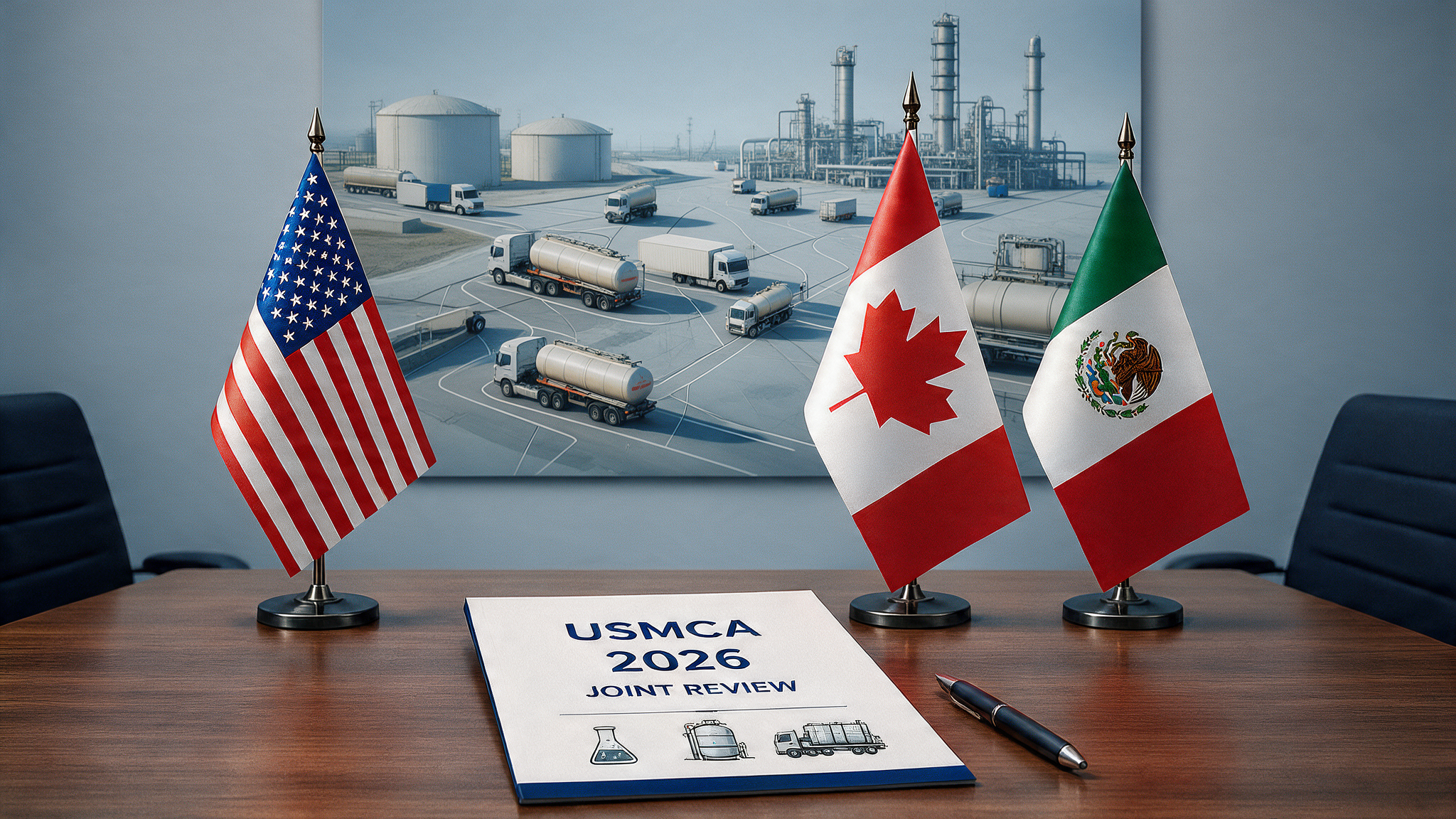
The 2026 Review
The three national chemical industry associations—ANIQ (Mexico), ACC (United States), and CIAC (Canada)—have coordinated their positions through a series of high-level trilateral meetings held in Mexico City, Ottawa, and at ACC headquarters in Washington, D.C. These engagements culminated in the launch of two industry-led workstreams: one focused on regulatory simplification and trade facilitation (reducing duplicative requirements, improving border efficiency, and streamlining processes), and another addressing structural excess capacity and rules of origin (strengthening enforcement, improving coordination, and preventing circumvention of trade rules).
Their stated objectives center on four core asks: preserving duty-free trade in chemical products, reinforcing regional integration across North American supply chains, promoting science- and risk-based chemical management, and accelerating the operationalization of the USMCA’s Chemical Sectoral Annex. As CIAC President Greg Moffatt stated, “CUSMA works, and it works especially well for an integrated sector like chemistry. As we approach the review, governments should focus on full implementation and enforcement, not renegotiation.”
Rules of Origin: The Chemical Reaction Rule
For exporters and importers seeking USMCA preferential treatment, the chemical reaction rule is the central origin criterion for most chemical products classified in Chapters 28–38 of the Harmonized Tariff Schedule. Under this rule, a good that results from a chemical reaction in the territory of one or more USMCA countries is treated as originating. The rule also recognizes purification (removal of at least 80% of existing impurities) and mixtures and blends (intentional, proportionally controlled mixing that produces a good with different physical or chemical characteristics) as qualifying operations.
The practical implication for ground freight carriers is that origin determination is not the carrier’s responsibility—it belongs to the exporter or importer. But the carrier is often the first party to discover that a shipment lacks the origin certification needed for preferential treatment, and the resulting delay falls on the logistics chain. For this reason, experienced chemical carriers build origin-document verification into their pre-departure checklist.
Tariff Environment
The chemical industry’s policy environment is not static. In 2025, the U.S. administration imposed 25% tariffs on imports from Canada and Mexico, with an additional 10% on Chinese goods. The Society of Chemical Manufacturers & Affiliates (SOCMA) warned that these tariffs “disrupt well-established supply chains and increase operational costs” for specialty chemical manufacturers. The mitigating factor is that goods compliant with USMCA rules of origin remain duty-free; Canada’s chemical and plastics exports to the U.S. have maintained high USMCA compliance rates, shielding most of the sector from the tariff impact.
The broader risk is investment deferral. As one industry executive observed in early 2025, “some investment decisions [are being] delayed pending clarity on trade policy and the upcoming USMCA renegotiation.” For logistics providers, this translates into demand volatility: pipeline projects delayed today become capacity shortages tomorrow. The shift to an annual review cycle, while preserving operational continuity, extends rather than resolves this policy uncertainty—making origin documentation discipline and regulatory compliance more important than ever for companies seeking to maintain preferential treatment eligibility.
USMCA: The Policy Questions Shaping the Industry
USMCA goes beyond tariffs for the chemical industry. Its Chemical Substances Annex addresses regulatory cooperation, supply chain resilience and alignment of chemical management systems.
Industry priorities are taking shape
Trilateral coordination
ANIQ, ACC and CIAC have coordinated industry positions through high-level meetings across North America.
Two workstreams
Regulatory simplification and trade facilitation; excess capacity and rules of origin.
Implementation focus
Industry objectives emphasize implementation, enforcement and stronger regional integration.
Two areas are central to the review
Regulatory Simplification & Trade Facilitation
Reducing duplicative requirements, improving border efficiency and streamlining processes.
Excess Capacity & Rules of Origin
Strengthening enforcement and coordination while addressing structural excess capacity and trade-rule circumvention.
Four core asks
Preserve duty-free trade
Maintain preferential treatment for qualifying chemical products.
Strengthen regional integration
Support interconnected North American chemical supply chains.
Science & risk-based management
Promote evidence-based approaches to chemical management.
Operationalize the Chemical Sectoral Annex
Accelerate practical implementation of its provisions.
The Chemical Reaction Rule
How chemical products can qualify
For most chemical products in Chapters 28–38, the chemical reaction rule is a central origin criterion for USMCA preferential treatment.
What this means for ground freight
Origin determination belongs to the exporter or importer, not the carrier. However, carriers may identify missing origin certification, creating delays throughout the logistics chain. Origin-document verification can therefore be included in pre-departure processes.
Trade policy can affect logistics planning
2025 U.S. tariffs
The U.S. administration imposed 25% tariffs on imports from Canada and Mexico in 2025.
USMCA preferential treatment
Qualifying goods that meet USMCA rules of origin can remain eligible for duty-free treatment.
The logistics takeaway
Origin documentation, regulatory compliance and proactive cross-border planning remain important for companies seeking to maintain preferential-treatment eligibility.