
Powering North America’s Next Economy: Energy, Critical Minerals, and Semiconductors in the USMCA Supply Chain
The autoparts industry taught North America how to build a single production platform across three countries. Now the same logic is being applied to the industries that will define the next decade: energy, critical minerals, and semiconductors. These are the inputs that make electric vehicles run, data centers operate, and advanced manufacturing possible. And like autoparts before them, they depend on freight moving reliably across the borders that separate Mexico, the United States, and Canada.
For logistics professionals, exporters, and importers, this is not a distant policy debate. It is a live operational reality, shaped by tariffs, rules of origin, border procedures, and the trusted trader programs that determine how quickly goods clear customs.
The Scale of Strategic Trade
The numbers underscore how deeply integrated these sectors have become. North America produces more oil and gas than any other region in the world, and energy trade between the three USMCA partners is foundational to the continent’s industrial base. Canada is the largest supplier of U.S. energy imports — including crude oil, natural gas, and electricity — and its share of U.S. crude oil imports by quantity increased from 41% (1.1 billion barrels) in 2015 to 64% (1.4 billion barrels) in 2025. In electricity, Canada supplied 81.3% of U.S. electricity imports in 2025, according to the Canada Energy Regulator. U.S. natural gas pipeline exports to Mexico reached record levels in 2025, averaging 7.5 billion cubic feet per day in May of that year, the most of any month on record.
In semiconductors, the stakes are even higher. The United States and Mexico currently depend on Asia for roughly 90% of their semiconductor supply, with Taiwan as the primary source. Mexico’s semiconductor consumption is projected at USD 18–22 billion in 2026, with imports covering over 90% of domestic demand. The U.S. runs a semiconductor trade surplus with both Canada and Mexico — $745 million and $10.7 billion respectively in 2024 — reflecting the deep integration of North American chip supply chains.
Critical minerals sit at the intersection of both. Mexico produces or holds development potential for at least 13 of the most sought-after critical minerals in global markets, among them lithium, copper, graphite, rare earths, antimony, barite, bismuth, fluorite, lead, manganese, phosphate, silver, titanium and zinc. Mexico ranks among the world’s top 15 producers in 19 minerals, 12 of which Washington classifies as critical. The country holds roughly 1.7 million tonnes of lithium across 82 identified deposits in 18 states, with Sonora leading with 13 deposits.
How deep does North American integration actually run?
Energy, semiconductors and critical minerals cross the same borders — and depend on the same freight corridors that move autoparts today.
Canada anchors U.S. energy imports
Canada’s share of U.S. crude oil imports by quantity
Deep integration — built on an Asian dependency
U.S. semiconductor trade surplus, 2024
Mexico sits at the intersection of both
Among the minerals in play
Where the lithium sits
Sonora leads the country in identified lithium deposits. Of the 19 minerals where Mexico ranks in the global top 15, 12 are classified as critical by Washington.
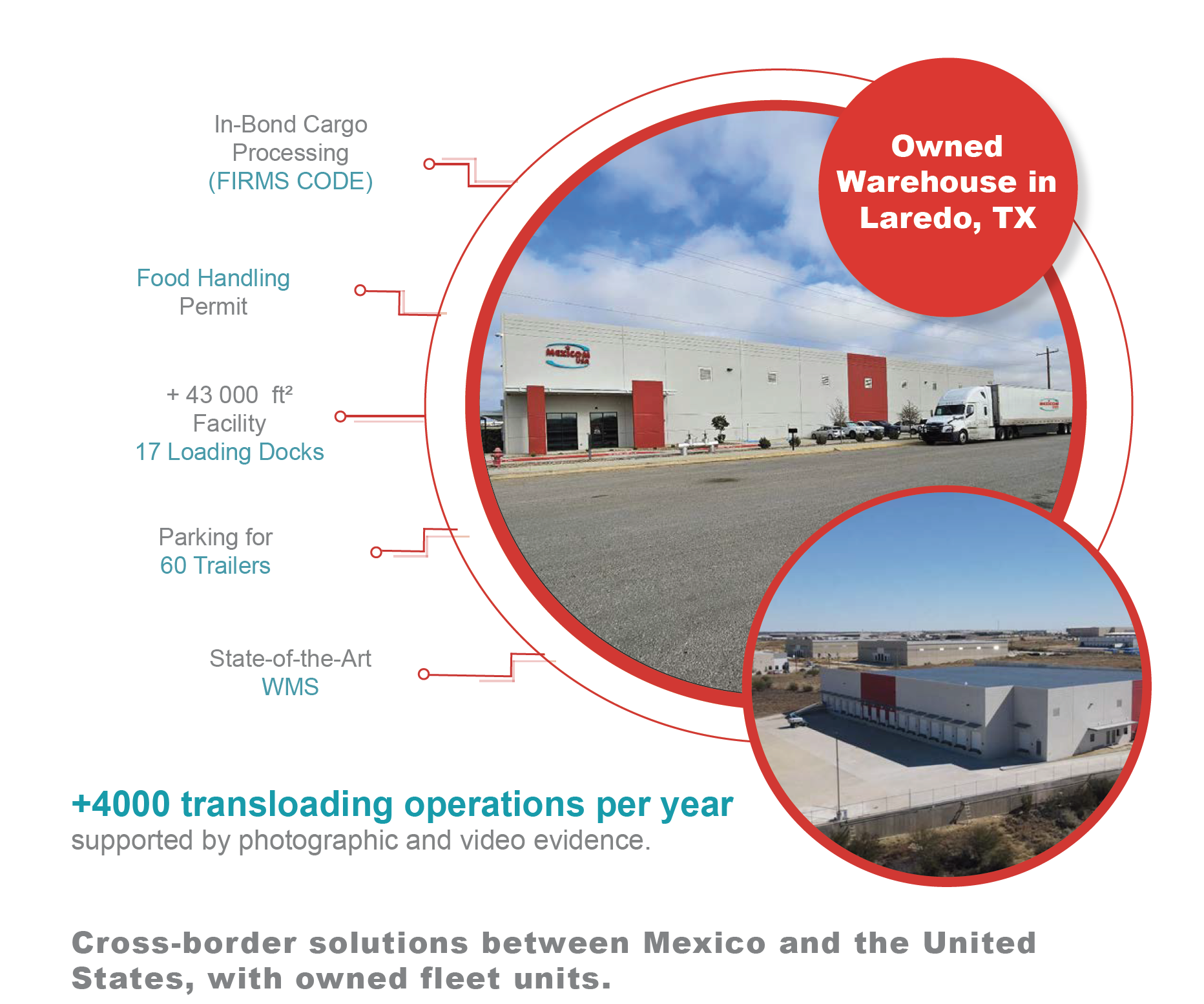
Strategically located in Laredo, our warehouse keeps your cross-border freight moving.
Contact us today
info@mexicomusa.com
Tel. +1 (956) 516-7201
Where the Resources and Production Are Concentrated
Mexico: Critical Minerals in the North, Semiconductors in the Bajío
Mexico’s critical mineral wealth is concentrated in the northern states. Sonora leads the country with 203 mining projects involving silver, zinc, copper, lithium, graphite, and rare earth elements. Chihuahua follows with 153 projects focused on silver, iron, and copper, while Durango hosts 112 initiatives mainly targeting silver, lead, zinc, and copper. Alongside Sinaloa and Zacatecas, these states represent 63% of Mexico’s energy-transition mineral portfolio. In Coahuila, Canada’s Discovery Metals Corp. is advancing rare earth exploration in what is currently the only project of its kind in the country.
According to USGS data, Mexico is among the top global producers of antimony, barite, copper, fluorite, graphite, lead, silver, and zinc. In 2025, Mexico produced 5,780 tonnes of silver, 773,000 tonnes of zinc, 180,000 tonnes of lead, and 900 tonnes of graphite. Mexico ranks first worldwide in silver production, second in fluorite, fifth in barite and molybdenum, sixth in magnesium and zinc, and seventh in lead and gold. However, in graphite, the gap with China remains vast: China produced approximately 1.4 million tonnes in 2025 — 82% of the world market — while Mexico produced 740 tonnes.
Mexico’s semiconductor ambitions are equally geographically defined. The government’s Plan México, launched in January 2025, set a target to multiply semiconductor production by 25 times in three years and attract $10 billion in investment by 2030. The Kutsari project aims to produce semiconductors in three strategic locations: Querétaro, Jalisco, and Nuevo León. Mexico’s Economy Secretariat identified Jalisco, Chihuahua, Baja California, and Querétaro as the states with the greatest potential and infrastructure for semiconductor fabrication. QSM Semiconductores, based in Querétaro, is preparing a plant that will begin volume production in 2027 as part of a project exceeding $100 million to develop three factories. The central-western region (Jalisco, Querétaro) saw its semiconductor company count grow from 56 in 2015 to 118 in 2023, with its share rising from 11% to 23%.
The semiconductor value chain has a crucial characteristic for logistics: fabrication plants require investments exceeding $10 billion per facility, but the remaining phases — packaging, testing, and integration — concentrate about 70% of the total value-add and require lower capital expenditures. This is where Mexico is positioning itself, and it means component flows will be multi-directional: wafers and materials in, packaged chips out, across the same border corridors used by the autoparts industry.
United States: Energy Dominance and Advanced Chip Design
The United States contributes what no other USMCA partner can match: scale in energy production and dominance in semiconductor design. The U.S. is the primary supplier of natural gas to Mexico, providing more than 80% of Mexico’s natural gas imports. In May 2025, U.S. natural gas pipeline exports to Mexico averaged 7.5 billion cubic feet per day, the most of any month on record. In crude oil, Canada’s share of U.S. imports rose to 64% in 2025, but the U.S. remains a major producer and refiner, with energy flows moving in both directions across the continent.
In critical minerals, the U.S. is both a producer and a consumer. It relies on Canada for aluminum and steel, and on Mexico for copper, silver, and a growing range of critical minerals. Since January 2025, Washington has directed more than US$1 billion into critical minerals investments across Latin America, targeting lithium, copper, and rare earths vital to energy, defense, and advanced technology supply chains, according to a report by law firm White & Case. The National Association of Manufacturers has urged USTR to offer duty-free imports of critical minerals and regulatory alignment in the sector, recognizing that American manufacturing depends on secure access to these inputs.
In semiconductors, the U.S. leads in chip design and advanced fabrication, but depends on cross-border flows of materials, components, and finished chips. The Semiconductor Industry Association (SIA) has formally called on USMCA negotiators to adjust rules of origin for the semiconductor sector to strengthen North American integration and investment. SIA member companies have design, R&D, and advanced packaging operations in Canada and back-end facilities in Mexico, and the USMCA supports a supply chain “tightly linked throughout the production process, with subcomponents and semiconductors crossing between the U.S., Canada, and Mexico before being integrated into a wide range of downstream industries”.
Canada: Aluminum, Electricity, and a Strategic Minerals Partner
Canada’s contribution to the North American strategic supply chain is anchored in materials and energy. It supplied more than 80% of U.S. electricity imports in 2025, according to the Canada Energy Regulator. Canada’s electricity exports to the U.S. were valued at $3.3 billion in 2025, while it imported $1.4 billion in power from the United States.
In critical minerals, Canada has taken an increasingly assertive posture. The Canadian Critical Minerals Strategy has provided $3.8 billion in funding to increase the supply of critical minerals and established a new Critical Minerals Sovereign Fund (CMSF) to make federal investments in the critical mineral value chain. Canada and the United States have a cooperation agreement on critical minerals that took root in the Biden administration and continues under the Trump administration. However, as trade tensions escalated in 2026, Canada signaled less interest in sharing its minerals freely. Energy and Natural Resources Minister Tim Hodgson said, “Nothing would make me happier than when the United States asks us for more electricity to say, ‘You know what, we’ve got a lot of mines we need to develop in northern British Columbia'”. Canada extended a behind-the-scenes offer to alliance members for “priority access” to Canada’s critical minerals stockpile, according to a letter seen by POLITICO.
Canadian mining firms are also active in Mexico. The potential for a coordinated Canada–Mexico critical minerals strategy is significant, given the presence of Canadian mining companies operating in Mexican territory and the complementary nature of their mineral portfolios. In Coahuila, Canada’s Discovery Metals Corp. is advancing rare earth exploration.
How the Three Countries Are Interconnected
The integration of energy, critical minerals, and semiconductors follows the same pattern established by autoparts: components and materials cross borders multiple times as they move from extraction to processing to manufacturing.
Energy flows south and east. Canadian crude and refined products move to U.S. refineries and then to Mexican industrial consumers. U.S. natural gas flows through pipelines to Mexican power plants and manufacturing clusters. Mexico’s pipeline imports of natural gas from the United States averaged 6.638 billion cubic feet per day in 2025, and 90% of the gas acquired by Mexico comes from the United States, primarily through border pipelines. Electricity moves across the U.S.–Canada border through transmission lines supported by a bilateral addendum to the USMCA that ensures non-preferential treatment on transmission. Mexico’s 2025 energy reforms, which consolidated a state-led model through PEMEX and CFE, have introduced friction into this relationship. Under current Mexican law, CFE must produce at least 54% of the power generated in Mexico, and PEMEX and CFE have been elevated as “strategic” national players with priority across the energy chain. These reforms partially reversed the 2013 energy opening and restored PEMEX and CFE to public-entity status, giving them preference over private competitors.
Critical minerals flow north and south. Copper from Sonora and Chihuahua moves to U.S. smelters and manufacturers. Silver from Mexico feeds into electronics and solar panels. Aluminum from Canada moves to U.S. and Mexican manufacturing facilities. Mexico’s ability to compete for U.S. critical minerals investment will hinge on the policy signals its government sends in 2026. The Inter-American Development Bank projects Mexico’s economy will grow approximately 1.3% in 2026 and identifies developing the country’s critical minerals sector as a concrete lever to improve that trajectory through increased investment, export growth, and higher fiscal revenues. As Rafael Rebollar, director general of Industrias Peñoles, noted at the 2026 Durango Mining Congress, Mexico must focus on integrating strategic value chains and expanding refining capacity: “There is no point in extracting the minerals and sending them to Asia”.
Semiconductors flow in both directions, but in different stages of production. Wafers and raw materials move from the U.S. and Asia into Mexican packaging and testing facilities. Finished chips move north to U.S. and Canadian manufacturers of electronics, vehicles, and industrial equipment. As Mexico’s semiconductor ecosystem develops, the flow will become more balanced, but the cross-border nature of the supply chain is permanent. The Kutsari project and Plan México framework position advanced display component manufacturing as a priority nearshoring sector eligible for accelerated depreciation, VAT certification, and IMMEX duty relief, creating a supply chain corridor that reduces transit time and tariff exposure for MicroLED process equipment and sub-assemblies entering North American end-product integration lines.
This interconnection is not theoretical. A single electric vehicle illustrates the pattern: lithium from Sonora, copper from Chihuahua, aluminum from Quebec, semiconductor chips packaged in Querétaro, and final assembly in Michigan or Ontario. Each of these inputs crosses at least one border, often more, before the vehicle is complete.
Where Mexico’s strategic inputs actually come from
Mining is concentrated in the north. Chip packaging and testing are taking shape in the Bajío and the west. Both feed the same cross-border freight corridors.
The northern bloc carries the portfolio
Mining projects by state
What each state targets
Why it matters
Sonora, Chihuahua, Durango, Sinaloa and Zacatecas together represent 63% of Mexico’s energy-transition mineral portfolio. In Coahuila, Canada’s Discovery Metals Corp. is advancing rare earth exploration — currently the only project of its kind in the country.
Mexico’s standing in global mineral markets
World ranking by commodity
Mexico is also among the top global producers of antimony, barite, copper and fluorite, according to USGS data.
The graphite gap is the hard part
2025 graphite production, to scale
Bars are drawn to scale. Mexico’s bar is a sliver — roughly 0.05% of China’s output, which represents about 82% of the world market. The same pattern applies to battery-grade processing capacity, where the constraint is refining rather than extraction.
A deliberate bet on packaging, testing and integration
Company growth, Jalisco & Querétaro
The region’s share of national semiconductor companies rose from 11% to 23% over the same period.
States flagged for greatest potential
QSM Semiconductores, based in Querétaro, is preparing a plant for volume production in 2027, as part of a project exceeding $100 million to develop three factories.
Where the value sits — and why that matters for freight
Fabrication plants require capital exceeding $10 billion per facility. The downstream phases — packaging, testing and integration — concentrate roughly 70% of the total value-add at far lower capital cost. That is the segment Mexico is targeting, and it makes component flows multi-directional: wafers and materials in, packaged chips out, along the same corridors used today for autoparts.
Three flows, one continent
Canadian crude and refined products move to U.S. refineries, then on to Mexican industrial consumers. U.S. gas moves south through border pipelines. Mexico’s pipeline imports of U.S. natural gas averaged 6.638 Bcf/d in 2025, with roughly 90% of Mexico’s gas supply coming from the United States.
Copper from Sonora and Chihuahua moves to U.S. smelters and manufacturers. Silver feeds electronics and solar panels. Aluminum from Canada moves into U.S. and Mexican plants. As Industrias Peñoles director general Rafael Rebollar put it: “There is no point in extracting the minerals and sending them to Asia.”
Wafers and raw materials move from the U.S. and Asia into Mexican packaging and testing facilities. Finished chips move north to U.S. and Canadian manufacturers of electronics, vehicles and industrial equipment. The cross-border nature of the chain is permanent.
One electric vehicle, five borders
Each input crosses at least one border — often more — before the vehicle is complete. The route is identical to the autoparts corridors already in daily use.
What the three governments are saying
Nothing would make me happier than when the United States asks us for more electricity to say, ‘You know what, we’ve got a lot of mines we need to develop in northern British Columbia.’ Tim Hodgson · Canada’s Minister of Energy and Natural Resources
Canada’s position
The Canadian Critical Minerals Strategy has directed $3.8 billion toward increasing critical mineral supply, and established a Critical Minerals Sovereign Fund. Electricity exports to the U.S. were valued at $3.3 billion in 2025, against $1.4 billion in imports.
The U.S. position
Since January 2025, Washington has directed more than US$1 billion into critical minerals investments across Latin America, targeting lithium, copper and rare earths. The Semiconductor Industry Association has called on USMCA negotiators to adjust semiconductor rules of origin, noting that member companies run design, R&D and advanced packaging in Canada and back-end facilities in Mexico.
The Inter-American Development Bank projects Mexico’s economy will grow approximately 1.3% in 2026 and identifies critical minerals development as a concrete lever to improve that trajectory. Mexico’s 2025 energy reforms, which require CFE to produce at least 54% of national power and elevate PEMEX and CFE as strategic players, have introduced friction into the energy relationship.
The Regulatory Framework: Rules of Origin, Tariffs, and Trusted Trader Programs
Critical Minerals and Rules of Origin
The USMCA’s rules of origin, originally designed around automotive content, are now being extended to critical minerals and semiconductors. The agreement established a critical minerals requirement that escalates over time: 40% regional content before 2024, 50% in 2024, 60% in 2025, 70% in 2026, and 80% after December 31, 2026. For automotive vehicles, the Regional Value Content requirement is 75% for passenger vehicles, while heavy trucks must meet 64% in 2026, rising to 70% in 2027.
These thresholds are not simply paperwork. They determine whether a shipment qualifies for duty-free treatment or faces tariffs that can reach 50% on steel and aluminum products under Section 232. For critical minerals, Mexico and the United States launched a Joint Action Plan in February 2026 to coordinate supply chain resilience, including the exchange of information between the U.S. Geological Survey and the Mexican Geological Service on the presence of critical minerals, and the creation of strategic storage mechanisms. The U.S. has proposed a 50% requirement for vehicle content from U.S. sources and a 100% requirement for North American-produced steel and aluminum in vehicles, along with expanded cooperation among the three nations to tighten security around critical minerals, batteries, and strategic manufacturing.
The BlueGreen Alliance has advocated for strengthening automotive rules of origin to encourage the use of critical minerals of North American origin, and for extending “melt-and-pour” origin standards for steel to aluminum, copper, and critical minerals. The 2026 joint review of the USMCA presents an opportunity for North America to establish specific regional-value-content thresholds for critical minerals and components that align with Inflation Reduction Act thresholds and extend to Canada-Mexico-U.S. projects in copper, lithium, nickel, and graphite.
Semiconductors and Export Controls
Semiconductor trade is governed by a more complex set of rules than autoparts. Rules of origin for semiconductors typically rely on a “tariff shift” — a change in tariff classification during regional production — or a Regional Value Content threshold of 60% by transaction value or 50% by net cost. Digital semiconductors classified under HS Chapter 85 may be subject to import permits or restrictions depending on their characteristics and intended end use.
The Semiconductor Industry Association has urged USMCA negotiators to ensure that rules of origin “strengthen U.S. semiconductor competitiveness, encourage greater investment in North American supply chains, and account for differences in existing and planned supply chain operations to produce different types of semiconductors”. SIA President and CEO John Neuffer has emphasized that the USMCA is vital to the success of the U.S. semiconductor industry and America’s global technology leadership.
Export controls add another layer. The U.S. has tightened controls on sensitive technologies under the Export Administration Regulations, and has been pressuring Mexico to exclude Chinese AI hardware from its supply chains. The U.S. is discussing a rules-of-origin proposal with Mexico that would limit the amount of components from outside North America in AI hardware production, as part of USMCA negotiations. USTR has formally requested tightening automotive rules of origin under the USMCA, identifying “critical vulnerability” in dependence on semiconductors, circuit boards, and screens from non-market economies or third countries. Washington seeks to extend regional content requirements to semiconductors, electronics, and critical minerals to reduce dependence on Chinese inputs.
Cross-Border Transportation: Regulations and Process
Moving energy, minerals, and semiconductor components across borders requires a distinct set of procedures for each commodity.
Energy and minerals moving by ground transport typically require commercial invoices, packing lists, bills of lading, and USMCA certificates of origin if preferential treatment is claimed. Mexico’s Carta Porte digital document is mandatory for all freight movements within Mexico, detailing origin, destination, and contents. For minerals, additional documentation may be required to demonstrate compliance with environmental and labor standards, particularly as supply chain due diligence requirements expand. The 2026 review is expected to address non-tariff barriers in Mexico’s energy market and discipline state-owned enterprise behavior, issues that directly affect the documentation and compliance burden for energy shippers.
Semiconductor components face additional scrutiny. Customs authorities are increasingly focused on origin verification for chips, given concerns about transshipment through Mexico to avoid U.S. tariffs on Chinese goods. The U.S. has proposed rules that would limit the amount of non-North American content in AI hardware produced in Mexico, which would directly affect the documentation and tracing requirements for semiconductor shipments. More than half of U.S. motor vehicle producers raised concerns about the cost or availability of lithium-ion batteries produced in USMCA countries, according to USITC reports, and the rules may not have fully accounted for nontraditional automotive components such as e-axles, semiconductors, cameras, touchscreens, and advanced batteries.
Security and trusted trader programs are particularly valuable in these sectors. C-TPAT certification reduces the likelihood of customs examinations by a factor of five, and AEO certification in Mexico provides similar benefits for southbound and northbound shipments. The FAST lane — available only to certified importers, carriers, and drivers — allows qualified shipments to clear customs with minimal delay, which is critical for time-sensitive semiconductor components and high-value mineral concentrates. In a sector where rules of origin are tightening and verification is becoming more rigorous, a carrier’s trusted trader certification is not a luxury — it is an operational requirement.
Tariffs and Trade Measures
The tariff landscape for strategic goods is more complex than for autoparts. Section 232 tariffs of 25% on steel and aluminum and 50% on certain metals apply to many products from Mexico and Canada, even with USMCA in effect. In February 2026, the U.S. Supreme Court held that IEEPA does not give the President authority to impose tariffs. Subsequently, the Administration ended the IEEPA tariff actions and imposed a 10%, 150-day “temporary import surcharge” on most U.S. imports, including from Canada, under Section 122 of the Trade Act of 1974. Under USMCA, Canadian goods that are certified as having met product-specific rules can enter the United States largely duty-free; such goods also are largely, but not wholly, exempt from U.S. tariff actions. In 2025, the United States imposed duties on about 13% of U.S. imports from Canada, worth about $50.5 billion total, while most Canadian goods entered duty-free because they were certified as USMCA-compliant.
The practical implication is that tariff engineering — the strategic structuring of product classification, origin claims, and supply chain documentation — has become as important as logistics efficiency. Companies that can demonstrate USMCA compliance for their critical mineral and semiconductor shipments can avoid tariffs that would otherwise make their products uncompetitive. For companies relying on cross-border shipments, the difference between a compliant and non-compliant origin claim can be measured in hundreds of thousands of dollars per shipment.
Rules of origin, tariffs and the cost of getting it wrong
Content thresholds are climbing, semiconductor rules run on a different rulebook, and the tariff landscape shifted twice in 2026. Here is what applies today.
Critical minerals content requirement, year by year
2024
Dec 31, 2026
These thresholds determine whether a shipment qualifies for duty-free treatment or faces tariffs reaching 50%. They are not paperwork — they are the difference between a competitive landed cost and an uncompetitive one.
What applies now — and what is on the table
In force today
U.S. proposals under discussion
Dashed bars indicate proposals, not current requirements. Industry stakeholders — including the American Automotive Policy Council — have cautioned that “overly rigid rules of origin or broad penalties could disrupt complex supply chains and raise costs for U.S. manufacturers.”
A different rulebook entirely
Where the RVC threshold is not used, origin can be established by a tariff shift — a change in tariff classification occurring during regional production.
The U.S. has tightened controls on sensitive technologies under the Export Administration Regulations and is pressuring Mexico to exclude Chinese AI hardware from its supply chains. A rules-of-origin proposal under discussion would limit non-North American components in AI hardware production.
USTR has requested tightening automotive rules of origin, identifying a “critical vulnerability” in dependence on semiconductors, circuit boards and screens from non-market economies or third countries.
Rules of origin should strengthen U.S. semiconductor competitiveness, encourage greater investment in North American supply chains, and account for differences in existing and planned supply chain operations to produce different types of semiconductors. Semiconductor Industry Association · Comments on the USMCA Joint Review
What actually applies to strategic goods
U.S. duties applied to imports from Canada, 2025
Most Canadian goods entered duty-free because they were certified as USMCA-compliant. Compliant goods are largely — though not wholly — exempt from U.S. tariff actions. For companies relying on cross-border shipments, the difference between a compliant and non-compliant origin claim can be measured in hundreds of thousands of dollars per shipment.
Certification changes the math at the border
A single non-certified supplier or carrier can disqualify an entire shipment from FAST lane access. Certification is not held by one party — it must hold across the whole movement.
Energy and mineral shipments require commercial invoices, packing lists, bills of lading and USMCA certificates of origin where preference is claimed. The Carta Porte is mandatory for all freight movements within Mexico.
Customs authorities are increasingly focused on origin verification for chips, given concerns about transshipment through Mexico to avoid U.S. tariffs on Chinese goods.
In a sector where rules of origin are tightening and verification is becoming more rigorous, trusted trader certification is not a luxury — it is an operational requirement.
The USMCA Review: What’s at Stake
The first mandatory joint review of the USMCA began on July 1, 2026. The United States declined to automatically renew the agreement for another 16-year term, opting instead for annual reviews through 2036. This shift introduces prolonged policy uncertainty for an industry that depends on predictability. As the Center for Strategic and International Studies (CSIS) noted, the review “is becoming something far more consequential: a stress test of whether North America can function as a coherent technology and economic-security platform in an era of intensified strategic competition globally”. The CSIS analysis further observed that “U.S. trade policy in the Western Hemisphere is now being operationalized as economic security policy, with market access used to enforce supply-chain discipline and geopolitical alignment rather than tariff reciprocity alone”.
Critical minerals and energy are central to the review. The U.S. is seeking mineral supply guarantees, while Canada and Mexico are pursuing lower tariffs on metals and deeper integration in mineral supply chains. Mexico and the U.S. have launched a joint action plan on critical minerals, but Canada has opted to keep its minerals cooperation baked into the USMCA review rather than signing a separate bilateral agreement. The U.S. has focused on “onshoring” by leveraging market access to “investment commitments,” particularly in technology sectors such as semiconductors, advanced computing, and AI-enabled infrastructure. These “strategic” sectors are now viewed primarily through a national security lens rather than a simple trade issue.
Energy is another flashpoint. The U.S. and Canada are demanding nondiscriminatory market access, challenging Mexico’s 2025 constitutional energy reforms that grant CFE priority grid dispatch and guarantee state-owned entities a minimum 54% stake in private electricity and renewable generation. Mexico’s 80% import dependency on U.S. natural gas gives Washington significant leverage, but also means that any disruption to energy trade would have immediate consequences for Mexican industrial production. Mexico’s 2025 energy reforms partially reversed the 2013 opening to private investment and restored PEMEX and CFE to public-entity status, giving them preference over private competitors.
For semiconductors, the review is an opportunity to establish clearer rules of origin and export control coordination. The U.S. has been pressuring Mexico to accept new rules for AI hardware exports that would exclude Chinese components, as part of USMCA negotiations. The Semiconductor Industry Association has recommended that USTR push for changes to rules of origin for the sector to increase competitiveness and investment in North America. Mexico’s Economy Secretary Marcelo Ebrard has said that semiconductor manufacturing will be a central topic in the new phase of North American economic integration, acknowledging that continuing to import all semiconductors from Asia is “very complicated, very expensive, and very difficult.”
Industry groups have weighed in extensively. The National Association of Manufacturers has asked USTR to offer duty-free imports of critical minerals, resolve non-tariff barriers in Mexico’s energy market, discipline state-owned enterprise behavior, and simplify customs documentation. The BlueGreen Alliance has recommended simplifying compliance for producers while maintaining strong regional value content thresholds, incentivizing use of North American-sourced critical minerals, and extending “melt-and-pour” origin standards for steel to aluminum, copper, and critical minerals. The American Automotive Policy Council and other industry stakeholders have emphasized that “overly rigid rules of origin or broad penalties could disrupt complex supply chains and raise costs for U.S. manufacturers”.
USITC is currently conducting a fact-finding investigation into how USMCA automotive rules of origin affect U.S. competitiveness in automotive production and trade, with a report due on July 1, 2027. Micah Burbanks-Ivey, an associate attorney at Holland & Knight, noted that he is particularly interested in how the study addresses strategic components for advanced and electric vehicles, such as critical minerals, batteries, and semiconductors, and that “the USITC report could critically shape some of these rules of origin, and, in a second order, the supply chain for these products”. The USITC will also examine auto prices, employment, and salaries, as well as broader economic indicators such as U.S. investment and gross domestic product.
Not a renewal — a stress test
The first mandatory joint review began on July 1, 2026. The United States declined automatic renewal, opening annual reviews through 2036. What follows is where the three governments stand, and what it means for freight.
How the review unfolds
Trade policy as economic security policy
It is becoming something far more consequential: a stress test of whether North America can function as a coherent technology and economic-security platform in an era of intensified strategic competition globally. Center for Strategic and International Studies (CSIS)
U.S. trade policy in the Western Hemisphere is now being operationalized as economic security policy, with market access used to enforce supply-chain discipline and geopolitical alignment rather than tariff reciprocity alone. Center for Strategic and International Studies (CSIS)
The practical consequence: the U.S. has focused on “onshoring” by leveraging market access to secure investment commitments, particularly in technology sectors such as semiconductors, advanced computing and AI-enabled infrastructure. These sectors are now viewed primarily through a national security lens rather than as a simple trade issue.
Critical minerals
Seeking mineral supply guarantees as a condition of continued preferential access.
Pursuing lower tariffs on metals and deeper integration in mineral supply chains. Has launched a joint action plan with the United States on critical minerals.
Also pursuing lower metal tariffs and supply chain integration, but has opted to keep minerals cooperation baked into the USMCA review rather than signing a separate bilateral agreement.
The divergence matters. Mexico has moved to a bilateral track with Washington while Canada has kept its position inside the trilateral process — two different negotiating postures on the same commodity set.
Energy
Demanding nondiscriminatory market access, challenging Mexico’s 2025 constitutional energy reforms that grant CFE priority grid dispatch and guarantee state-owned entities a minimum 54% stake in private electricity and renewable generation.
The 2025 reforms partially reversed the 2013 opening to private investment and restored PEMEX and CFE to public-entity status, giving them preference over private competitors.
Washington holds significant leverage through Mexico’s 80% dependency on U.S. natural gas — but the same dependency means any disruption to energy trade would have immediate consequences for Mexican industrial production. Leverage runs in both directions.
Semiconductors
Pressuring Mexico to accept new rules for AI hardware exports that would exclude Chinese components. Seeking clearer rules of origin and export control coordination.
Economy Secretary Marcelo Ebrard has said semiconductor manufacturing will be a central topic in the new phase of North American integration, acknowledging that importing all semiconductors from Asia is “very complicated, very expensive, and very difficult.”
The Semiconductor Industry Association has recommended that USTR push for changes to rules of origin for the sector to increase competitiveness and investment in North America.
Unlike minerals and energy, the semiconductor discussion is largely forward-looking — the rules being negotiated now will shape where packaging, testing and integration capacity gets built over the next decade.
What the groups have asked USTR for
Duty-free imports of critical minerals. Resolution of non-tariff barriers in Mexico’s energy market. Discipline on state-owned enterprise behavior. Simplified customs documentation.
Simplify compliance for producers while maintaining strong regional value content thresholds. Incentivize North American-sourced critical minerals. Extend “melt-and-pour” origin standards for steel to aluminum, copper and critical minerals.
The American Automotive Policy Council and other stakeholders warn that “overly rigid rules of origin or broad penalties could disrupt complex supply chains and raise costs for U.S. manufacturers.”
The USITC report could critically shape some of these rules of origin, and, in a second order, the supply chain for these products. Micah Burbanks-Ivey · Holland & Knight
Burbanks-Ivey noted particular interest in how the USITC study addresses strategic components for advanced and electric vehicles — critical minerals, batteries and semiconductors — categories the existing rules may not fully account for.
A tiered Western Hemisphere
A core group moving into deeper U.S.-aligned production and technology ecosystems. Preferential access continues, tied to supply-chain discipline and alignment on strategic sectors.
Others facing a choice between closer ties with China and privileged access to the U.S. market. The CSIS analysis notes developments across Central America already point in this direction.
For exporters and importers, the implication is that compliance posture is increasingly a market-access question, not just a customs formality. Where a company sources from — and how well it can document it — now factors into whether it sits inside or outside the preferred tier.
Five things this review changes in practice
Origin documentation must be traceable to the mine or the wafer. Escalating critical minerals content requirements and tariff shift rules demand supply chain visibility beyond what most companies maintain. Companies that cannot trace inputs to source risk losing preferential treatment and facing tariffs that can reach 50%.
Trusted trader programs deliver measurable advantages. C-TPAT and AEO reduce examination rates, accelerate border clearance and enable FAST lane access. A single non-certified supplier or carrier can disqualify an entire shipment from FAST access.
Tariff engineering is now a core logistics function. Product classification, origin claims and documentation must be managed strategically. Errors in classification or valuation produce tariffs, penalties and delays that ripple through the entire production schedule.
Contingency planning is essential. With annual reviews through 2036, rates and rules are subject to change. Accurate compliance documentation, multiple carrier relationships and flexible routing options absorb policy shifts without stopping production.
The corridors are the same, but the cargo is different. Laredo, El Paso and Detroit–Windsor were built around autoparts. They now carry lithium concentrates, aluminum ingots, semiconductor wafers and packaged chips.
Same routes, new commodities
Carriers that understand these commodities — their documentation requirements, their security sensitivities, their time constraints — are the ones positioned to keep North America’s next economy moving. For companies moving critical minerals, energy equipment or semiconductor components, the ability to combine AEO and C-TPAT certification with commodity-specific expertise and FAST lane access is what separates a supply chain that functions from one that stalls at the border.
Policy uncertainty is now a standing condition
The integration of energy, critical minerals and semiconductors across Mexico, the United States and Canada is not a future scenario. It is the present reality of North American manufacturing. What the review changes is the predictability horizon — from 16 years to 12 months at a time.
Companies that build compliance into their operations, participate in trusted trader programs, and partner with carriers who understand these sectors will be the ones that turn that uncertainty into competitive advantage.
The integration of energy, critical minerals, and semiconductors across Mexico, the United States, and Canada is not a future scenario. It is the present reality of North American manufacturing. What the USMCA review changes is the predictability horizon: from 16 years to 12 months at a time.
Companies that build compliance into their operations, participate in trusted trader programs, and partner with carriers who understand these sectors will be the ones that turn that uncertainty into competitive advantage.
Why choose Mexicom for cross-border transportation in North America
As the USMCA review redefines the rules of trade in North America, the ability to move critical minerals, semiconductors, and energy equipment across the borders of Mexico, the United States, and Canada becomes a decisive competitive advantage. Mexicom Logistics, with more than 20 years of experience and operational presence in all three countries, is positioned to lead this strategic corridor.
Proven experience: More than 20 years in international door-to-door ground transportation, with more than 3,640 loads crossing the Mexico–U.S. border every year. Integrated operations in Montreal (Canada), Laredo, Texas (cross-border hub), Mexico City, and Nuevo Laredo.
Own fleet and direct control: As an asset-based carrier, Mexicom directly controls tractors, trailers, and warehouses. This guarantees predictable capacity, greater reliability, and lower supply chain risk for industries that cannot afford delays.
Certifications and compliance: Network of C-TPAT-approved carriers with transit permits and 24/7 satellite tracking systems. Drivers with B-1 visas, In-Bond capability under CBP control, and regulatory compliance in all three countries. Operations aligned with the security standards required by the USMCA and trusted trader programs.
Solutions for critical minerals and semiconductors: Mexicom Logistics offers specialized services for the strategic supply chains defined by the USMCA review: full truckload (FTL), less-than-truckload (LTL), and Partial Truckload with Dry Van, Reefer, Flatbed, Step-Deck, and Double Drop equipment. For critical minerals and semiconductors, this means the ability to handle everything from lithium concentrates and aluminum ingots to wafers and chip sub-assemblies, with the documentation and security each commodity requires.
Strategic Laredo hub and 4PL solutions: The cross-border hub in Laredo, Texas — with its own 43,000-square-foot warehouse and 17 loading docks — enables cross-docking, consolidation, deconsolidation, and transloading operations. Added to this are 4PL solutions that include warehousing and distribution, cargo insurance, customs coordination, freight management, and logistics consulting, offering a single point of contact for the entire supply chain in Mexico, the U.S., and Canada.
For shippers of critical minerals, semiconductors, and energy equipment, the combination of own fleet, C-TPAT certifications, In-Bond capability, a Laredo hub, and experience in all three countries makes Mexicom Logistics the partner that guarantees cargo reaches its destination without stopping at the border. In an environment where rules of origin and tariffs change every year, having an operator that masters the customs process, the documents, and border crossing times is not an advantage: it is an operational necessity.
Mexicom Logistics — Cross-border freight transportation in Mexico, the United States, and Canada. Specialists in logistics for critical minerals, semiconductors, energy, and advanced manufacturing. Own fleet, C-TPAT certifications, Laredo hub, door-to-door and 4PL solutions.
Strategically located in Laredo, our warehouse keeps your cross-border freight moving.
Contact us today
info@mexicomusa.com
Tel. +1 (956) 516-7201
Sources:
- Congressional Research Service, U.S.-Canada Trade Relations, IF12595, updated 2026. https://www.congress.gov/crs_external_products/IF/PDF/IF12595/IF12595.31.pdf
- Mexico Business News, “Northern Mexico’s Rise as a Critical Mineral Powerhouse,” February 10, 2026. https://mexicobusiness.news/mining/news/northern-mexicos-rise-critical-mineral-powerhouse
- Mexico Business News, “Mexico to Compete for US Critical Minerals Investment,” March 17, 2026. https://mexicobusiness.news/mining/news/mexico-compete-us-critical-minerals-investment
- Semiconductor Industry Association, “Comments on the United States-Mexico-Canada Agreement (USMCA) Joint Review,” November 3, 2025. https://www.semiconductors.org/wp-content/uploads/2025/11/FINAL_SIA-Comments_USMCA-Review.pdf
- El Economista, “La mayor refinación minera aumentará el comercio libre de aranceles en el T-MEC,” August 27, 2026. https://www.eleconomista.com.mx/empresas/mayor-refinacion-minera-aumentara-comercio-libre-aranceles-t-mec-20260827-830556.html
- Center for Strategic and International Studies (CSIS), “USMCA 2026 and Economic Security: The Convergence of Technology, Trade, and National Security,” February 27, 2026. https://www.csis.org/analysis/usmca-2026-and-economic-security-convergence-technology-trade-and-national-security
- MarketResearch.com, “Mexico MicroLED Display Market 2025–2035,” June 3, 2026. https://www.marketresearch.com/Emergen-Research-v4369/Mexico-MicroLED-Display-Epitaxial-Growth-45459766/
- POLITICO, “Canada turns its critical minerals into leverage against Trump,” September 5, 2026. https://www.politico.com/news/2026/09/05/canada-turns-its-critical-minerals-into-leverage-against-trump-01065104
- WardsAuto, “USITC probes USMCA auto rules’ impact on industry competitiveness,” March 13, 2026. https://www.wardsauto.com/news/usitc-usmca-auto-rules-impact-on-industry/814691/
- Brookings Institution, “The impact of US tariffs on North American auto manufacturing and implications for USMCA,” May 14, 2025. https://www.brookings.edu/articles/the-impact-of-us-tariffs-on-north-american-auto-manufacturing-and-implications-for-usmca/
- U.S. Energy Information Administration, “U.S. natural gas exports to Mexico reach new records,” October 20, 2025. https://www.eia.gov/todayinenergy/detail.php?id=64584
- El Economista, “México produce ocho de los 60 minerales críticos de interés,” February 12, 2026. https://www.eleconomista.com.mx/empresas/mexico-produce-ocho-60-minerales-criticos-interes-20260212-798456.html
- Canada Energy Regulator, “Market Snapshot: Overview of 2025 Canada-U.S. Energy Trade,” May 26, 2026. https://www.cer-rec.gc.ca/en/data-analysis/energy-markets/market-snapshots/2026/market-snapshot-overview-of-2025-canada-us-energy-trade.html
- Mexico Business News, “Mexico Opens Door to Private Energy as USMCA Dispute Looms,” November 26, 2025. https://mexicobusiness.news/oilandgas/news/mexico-opens-door-private-energy-usmca-dispute-looms
- DPL News, “México | Fabricantes de chips piden ajuste en reglas de origen del T-MEC,” November 10, 2025. https://dplnews.com/mexico-fabricantes-de-chips-piden-ajuste-en-reglas-de-origen-del-t-mec/
- KPMG, “핵심광물을 미국 또는 미국과 FTA를 체결한 국가에서 일정 비율,” 2026. https://assets.kpmg.com/content/dam/kpmg/kr/pdf/2026/industry/2026-usmca-critical-minerals-requirement.pdf
- Incomex, “EE. UU. busca endurecer reglas de origen del T-MEC en sector automotriz,” July 22, 2026. https://incomex.org.mx/ee-uu-busca-endurecer-reglas-de-origen-del-t-mec-en-sector-automotriz/
- El Universal, “Pretende EU ampliar las reglas del T-MEC; semiconductores y electrónicos, en la mira,” August 3, 2026. https://www.eluniversal.com.mx/cartera/pretende-eu-ampliar-las-reglas-del-t-mec-semiconductores-y-electronicos-en-la-mira/
- CEIC Data, “Mexico Imports: Electronic Integrated Circuits & Microassemblies,” August 13, 2026. https://www.ceicdata.com/en/indicator/mexico/imports-electronic-integrated-circuits-microassemblies
- IndexBox, “Semiconductors Market in Mexico,” May 2, 2026. https://www.indexbox.io/store/mexico-semiconductors-market-report-analysis-size-share-trends-forecast-trade/
- Alzavoz, “Gobierno de México presenta avances en Kutsari para fabricar semiconductores en tres sedes,” August 14, 2025. https://www.alzavoz.com/gobierno-de-mexico-presenta-avances-en-kutsari-para-fabricar-semiconductores-en-tres-sedes/
- Mega Noticias, “La guerra de los chips; apuesta de México con EU,” April 3, 2026. https://www.meganoticias.mx/la-guerra-de-los-chips-apuesta-de-mexico-con-eu/
- Mexico Industry, “QSM Semiconductores: la empresa que pone a México en el mapa de los semiconductores,” September 1, 2026. https://mexicoindustry.com/qsm-semiconductores-la-empresa-que-pone-a-mexico-en-el-mapa-de-los-semiconductores/
- SGPJB, “2025墨西哥半导体生态系统报告,” August 28, 2026. https://www.sgpjbg.com/2025-mexico-semiconductor-ecosystem-report.html
- Forbes México, “Fabricación de hardware para IA triplica importaciones de Taiwán a México,” May 19, 2026. https://forbes.com.mx/fabricacion-de-hardware-para-ia-triplica-importaciones-de-taiwan-a-mexico/
- Forbes México, “Taiwán desplaza a China como mayor importador de productos para IA a México,” June 15, 2026. https://forbes.com.mx/taiwan-desplaza-a-china-como-mayor-importador-de-productos-para-ia-a-mexico/
- Politico, “Canada turns its critical minerals into leverage against Trump,” September 5, 2026. https://www.politico.com/news/2026/09/05/canada-turns-its-critical-minerals-into-leverage-against-trump-01065104
- Canadian Centre for Policy Alternatives, “‘Critical minerals’ strategy is going down a cynical road,” March 25, 2026. https://www.policyalternatives.ca/news-research/critical-minerals-strategy-is-going-down-a-cynical-road/
- El Economista, “México es clave en 10 minerales críticos para EU,” February 16, 2026. https://www.jornada.com.mx/2026/02/16/economia/018n1eco
- Debate, “Litio global crece 4,503% y México queda fuera del mercado,” April 23, 2026. https://www.debate.com.mx/litio-global-crece-4503-y-mexico-queda-fuera-del-mercado-20260423-001.html
- El Financiero, “México ‘hace méritos’ con Trump: Firma acuerdo para suministro de minerales críticos,” February 4, 2026. https://www.elfinanciero.com.mx/nacional/mexico-hace-meritos-con-trump-firma-acuerdo-para-suministro-de-minerales-criticos/
- El Economista, “Política minera mexicana puede limitar plan México-EU de minerales críticos,” February 26, 2026. https://www.eleconomista.com.mx/empresas/politica-minera-mexicana-puede-limitar-plan-mexico-eu-de-minerales-criticos-20260226-799456.html
- Opportimes, “Silver on the U.S. List of Critical Minerals: Camimex Calls It Significant,” August 28, 2026. https://www.opportimes.com/silver-on-the-u-s-list-of-critical-minerals-camimex-calls-it-significant/
- Expansión, “Minerales críticos. México en la mesa, ¿pero con qué menú?” March 2, 2026. https://esg.expansion.mx/mineria/2026/03/02/minerales-criticos-mexico-en-la-mesa-pero-con-que-menu
- Energy & Industry Magazine, “Minerales críticos abren un nuevo capítulo para la minería nacional,” April 2, 2026. https://energymagazine.mx/minerales-criticos-abren-un-nuevo-capitulo-para-la-mineria-nacional/
- Outlet Minero, “Minerales críticos: la carta estratégica de México en la nueva integración minera de Norteamérica,” February 27, 2026. https://outletminero.org/minerales-criticos-la-carta-estrategica-de-mexico-en-la-nueva-integracion-minera-de-norteamerica/
- Mexico Business News, “Mexico Moves to Secure Critical Minerals Amid Global Shifts,” February 12, 2026. https://mexicobusiness.news/mining/news/mexico-moves-secure-critical-minerals-amid-global-shifts
- Mexico Business News, “Stalled at SEMARNAT: What Firms Filing Applications Recommend,” July 30, 2026. https://mexicobusiness.news/mining/news/stalled-semarnat-what-firms-filing-applications-recommend
- Mexico Business News, “Mexico Cuts Gasoline Import Dependency; Natural Gas Imports Grow,” March 4, 2026. https://mexicobusiness.news/oilandgas/news/mexico-cuts-gasoline-import-dependency-natural-gas-imports-grow
- Natural Gas Intelligence, “Pipelines Over Politics: Mexico’s U.S. Gas Appetite Reaches New Heights,” November 7, 2025. https://www.naturalgasintel.com/pipelines-over-politics-mexicos-us-gas-appetite-reaches-new-heights/
- Global Energy, “México marca récord en importaciones de gas natural desde EU,” March 5, 2026. https://globalenergy.mx/mexico-marca-record-en-importaciones-de-gas-natural-desde-eu/
- Opportimes, “SIA calls for harmonization of semiconductor regulations in North America,” June 7, 2026. https://www.opportimes.com/sia-calls-for-harmonization-of-semiconductor-regulations-in-north-america/
- Opportimes, “La SIA pide alineación de normas sobre semiconductores en América del Norte,” June 7, 2026. https://www.opportimes.com/la-sia-pide-alineacion-de-normas-sobre-semiconductores-en-america-del-norte/
- Investor Wedbush, “USMCA Review Puts North America’s AI Backbone to the Test: Global Electronics Association Sounds Alarm,” December 1, 2025. https://investor.wedbush.com/usmca-review-puts-north-americas-ai-backbone-to-the-test-global-electronics-association-sounds-alarm/
- Electronics.org, “Strengthening North America’s Electronics Backbone,” November 10, 2025. https://www.electronics.org/strengthening-north-americas-electronics-backbone/
- Bilaterals.org, “T-MEC y EU. La agenda de la renegociación 2025-2026,” 2025. https://www.bilaterals.org/t-mec-y-eu-la-agenda-de-la-renegociacion-2025-2026
- Ifeng News, “近100%AI设备运往美国,墨西哥被敲打:排除中国成分,” September 16, 2026. https://news.ifeng.com/nearly-100-ai-equipment-shipped-to-us-mexico-pushed-to-exclude-chinese-components/
- Incomex, “Revisión del T-MEC podría redefinir cadenas de suministro automotrices,” June 25, 2026. https://incomex.org.mx/revision-del-t-mec-podria-redefinir-cadenas-de-suministro-automotrices/
- BlueGreen Alliance, “Comments on USMCA Review,” 2026. https://www.bluegreenalliance.org/comments-on-usmca-review/
- IAméricas, “The 2026 joint review of the USMCA presents an opportunity,” 2026. https://iamericas.org/the-2026-joint-review-of-the-usmca-presents-an-opportunity/
- WITA, “Could U.S.-Mexico Critical Minerals Deal Really Be a Technology Sovereignty Play?” February 9, 2026. https://www.wita.org/could-u-s-mexico-critical-minerals-deal-really-be-a-technology-sovereignty-play/
- Citrin Cooperman, “Key Takeaways from the 2026 NAM North American Manufacturing Conference,” June 9, 2026. https://www.citrincooperman.com/key-takeaways-from-the-2026-nam-north-american-manufacturing-conference/
- IndexBox, “USMCA review 2026: Key takeaways for shippers from Supply Chain Dive event,” July 27, 2026. https://www.indexbox.io/usmca-review-2026-key-takeaways-for-shippers-from-supply-chain-dive-event/
- Virginia Business, “As USMCA review looms, experts say auto industry’s future is uncertain,” February 6, 2026. https://virginiabusiness.com/as-usmca-review-looms-experts-say-auto-industrys-future-is-uncertain/
- WardsAuto, “USITC probes USMCA auto rules’ impact on industry competitiveness,” March 13, 2026. https://www.wardsauto.com/news/usitc-usmca-auto-rules-impact-on-industry/814691/
- USITC, “USMCA Automotive Rules of Origin: Economic Impact and Operation,” 2025. https://www.usitc.gov/publications/332/pub5642.pdf
- Canada Energy Regulator, “Electricity Trade Summary,” October 2, 2025. https://www.cer-rec.gc.ca/en/data-analysis/energy-markets/electricity-trade-summary.html
- U.S. Energy Information Administration, “U.S. natural gas exports to Mexico reach new records,” October 20, 2025. https://www.eia.gov/todayinenergy/detail.php?id=64584
- Mexico Business News, “Mexico Opens Door to Private Energy as USMCA Dispute Looms,” November 26, 2025. https://mexicobusiness.news/oilandgas/news/mexico-opens-door-private-energy-usmca-dispute-looms
- OPIS, “2026 Preview: Mexico Energy Overhaul to Test USMCA as July Review of Pact Approaches,” December 31, 2025. https://www.opis.com/2026-preview-mexico-energy-overhaul-to-test-usmca-as-july-review-of-pact-approaches/