

The Physical Supply Chain Behind AI: How Data Centers Are Transforming North America’s Freight, Warehousing, and Manufacturing Sectors
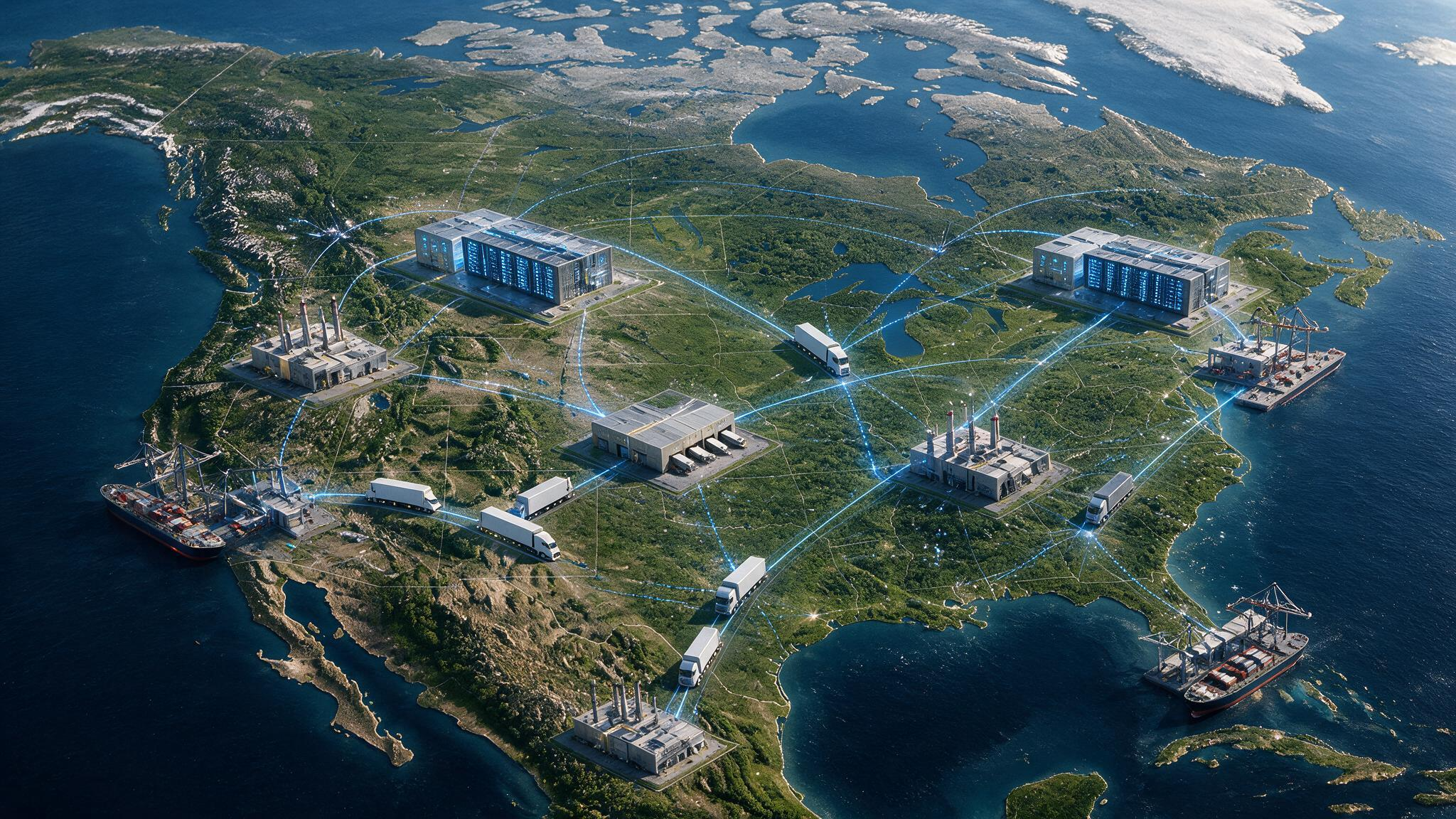
The biggest logistics story of 2026 isn’t AI software—it’s the physical supply chain being built to support AI. This is a multi-trillion-dollar industrial expansion that is creating demand across construction, transportation, warehousing, manufacturing, utilities, and cross-border trade.
Across the United States, Mexico, and Canada, billions of dollars are being invested into new data centers, energy infrastructure, manufacturing capacity, and logistics networks. These investments are creating demand across industries that have little to do with software but everything to do with supply chains.
Raw Materials
Steel, aluminum, copper, concrete, minerals, and industrial components.
Manufacturing
Electrical equipment, servers, cooling systems, cables, and hardware.
Transportation
Ocean freight, rail, trucking, air cargo, and specialized project logistics.
Warehousing
Secure storage, equipment staging, and AI infrastructure preparation.
Data Centers
Hyperscale facilities powering artificial intelligence applications.
Ongoing Logistics
Maintenance, replacement parts, upgrades, and technology shipments.
AI Isn’t Just a Software Revolution—It’s a Supply Chain Revolution:
Every AI Data Center Begins With a Supply Chain
When people think of AI, they often imagine powerful GPUs or advanced software. In reality, a modern AI data center is the culmination of thousands of individual supply chain movements.
Before the first server is installed, construction teams must receive structural steel, precast concrete, rebar, roofing materials, electrical switchgear, transformers, backup generators, industrial HVAC equipment, chillers, pumps, miles of copper wiring, fiber optic cable, and sophisticated fire protection systems.
Once the building is complete, another wave of logistics begins. Specialized transportation providers move high-value server racks, networking equipment, liquid cooling systems, batteries, and power distribution units under tightly controlled conditions. Many of these shipments require enhanced security, precise scheduling, and white-glove handling to protect sensitive electronics.
Even after operations begin, the supply chain continues. Data centers require a constant flow of replacement components, maintenance parts, cooling fluids, electrical equipment, and upgraded computing hardware throughout their operational life.
In other words, AI infrastructure is not a one-time construction project—it creates a continuous logistics ecosystem.
Every one of these components must be manufactured, transported, stored, and delivered—creating significant opportunities for logistics providers across the United States, Mexico, and Canada.
For freight brokers, third-party logistics providers (3PLs), trucking companies, customs brokers, warehouse operators, and manufacturers, AI represents much more than a technology trend. It is rapidly becoming one of the largest industrial logistics opportunities in decades.
Every new AI data center requires thousands of physical components that must move through North American supply chains.
These include:
- Steel structures
- Precast concrete
- Electrical transformers
- High-voltage switchgear
- Backup generators
- Industrial cooling systems
- Fiber optic cable
- Copper wiring
- Liquid cooling equipment
- Thousands of server racks
- NVIDIA GPUs
- Power distribution units
- Batteries
- Security equipment
Each of these products generates freight movements by truck, rail, ocean, and air before a data center ever comes online.
A New Type of Freight Is Emerging
The AI boom is changing the type of freight moving across North America.
Unlike traditional consumer goods transportation, AI infrastructure relies heavily on project logistics. Shipments are often larger, more expensive, and more complex than standard freight.
A single AI campus may require the transportation of:
- Massive electrical transformers
- Industrial cooling equipment
- Server racks
- Power systems
- Construction materials
- Fiber optic infrastructure
- Battery storage equipment
These shipments require logistics providers capable of managing oversized cargo, complex routing, permits, customs requirements, and precise delivery schedules—capabilities that define Mexicom Group’s expertise.
For freight brokers, carriers, 3PLs, and customs specialists, AI represents a new category of industrial freight.
The Energy Supply Chain Has Become Part of AI Logistics
One of the biggest challenges facing AI expansion is energy.
AI data centers consume extraordinary amounts of electricity, making power availability one of the most important factors when companies decide where to build new facilities.
As a result, the AI supply chain now extends beyond transportation and manufacturing into the energy sector.
New AI campuses require:
- Electrical substations
- Transmission infrastructure
- Natural gas systems
- Renewable energy projects
- Battery storage
- Utility construction
Energy companies are increasingly becoming infrastructure partners because supplying power has become just as important as supplying computing equipment.
Warehousing Is Entering a New Era
The AI infrastructure boom is also transforming warehouse operations. Historically, warehouses have primarily supported retail distribution, manufacturing, or e-commerce fulfillment. AI infrastructure introduces entirely new requirements.
Instead of shipping consumer products, specialized facilities are now being designed to support:
- Secure storage of AI servers and networking equipment
- Inventory staging for multi-billion-dollar construction projects
- Rack integration and equipment pre-assembly
- Configuration of networking hardware
- White-glove handling of sensitive electronics
- Reverse logistics for equipment upgrades and replacements
North America’s Role in the AI Revolution: How the United States, Mexico, and Canada Are Building the Infrastructure Behind Artificial Intelligence
🇺🇸 United States
- Hyperscale data centers
- AI companies and cloud providers
- NVIDIA GPU ecosystem
- Energy infrastructure
- Technology investment capital
- Advanced computing capacity
🇲🇽 Mexico
- Electronics manufacturing
- Industrial equipment production
- Metal fabrication
- Cable assemblies
- Nearshoring opportunities
- Mexico-U.S. logistics corridors
🇨🇦 Canada
- Clean electricity
- Hydroelectric power
- Critical minerals
- Aluminum production
- AI research centers
- Advanced engineering
United States: The Center of AI Infrastructure Investment
The United States is currently the global leader in AI infrastructure investment, driven by the presence of the world’s largest technology companies, significant venture capital investment, and access to capital markets.
Companies such as Microsoft, Amazon Web Services, Google, Meta Platforms, Oracle, and OpenAI are investing billions of dollars into AI infrastructure, including data centers, cloud computing capacity, and energy systems.
Microsoft — expanding AI-focused data center capacity through partnerships and investments in computing infrastructure.
Amazon Web Services — investing billions into AI-ready cloud infrastructure and data centers.
Google — expanding its global data center network to support artificial intelligence services.
Meta Platforms — developing large-scale AI computing campuses.
Oracle — increasing AI cloud capacity and infrastructure investments.
xAI — building large AI computing facilities requiring significant power and infrastructure.
NVIDIA — supplying the advanced GPUs and AI hardware driving demand for new computing capacity.
The scale of investment is unprecedented.
The International Data Corporation (IDC) and other industry analysts estimate that global spending on AI infrastructure, software, and services will reach hundreds of billions of dollars over the coming years, with the United States capturing a significant share of this investment.
The country’s role is centered around:
1. AI Computing Infrastructure
The U.S. hosts many of the largest AI computing facilities in the world. These campuses require:
- Thousands of advanced servers
- NVIDIA GPUs
- High-performance networking equipment
- Massive cooling systems
- Dedicated electrical infrastructure
Companies such as NVIDIA are central to this ecosystem because their GPUs have become essential components for training and operating advanced AI models.
2. Data Center Expansion
States such as Texas, Virginia, Arizona, Ohio, and Georgia have become major AI infrastructure hubs.
Texas, in particular, is emerging as one of the most important locations because of:
- Available land
- Energy resources
- Industrial capacity
- Growing renewable energy production
- Business-friendly policies
Large AI campuses require more than buildings. They require entire infrastructure networks, including:
- Power generation
- Electrical substations
- Transmission lines
- Fiber networks
- Construction supply chains
This means AI investment is creating demand across traditional industries such as construction, energy, transportation, and manufacturing.
3. Energy Infrastructure
One of the biggest challenges facing AI growth is electricity.
AI data centers consume significantly more power than traditional cloud facilities. As a result, energy has become a strategic component of the AI supply chain.
The United States is investing in:
- Natural gas infrastructure
- Renewable energy projects
- Nuclear power initiatives
- Battery storage
- Grid modernization
The future of AI will depend not only on computing power but also on the ability to deliver reliable electricity.
Mexico: The Manufacturing and Nearshoring Opportunity
Mexico’s role in the AI revolution is different from the United States.
While the U.S. is building many of the world’s largest AI campuses, Mexico has the opportunity to become one of the most important manufacturing partners supporting this expansion.
Mexico already has one of the most integrated manufacturing relationships with the United States.
According to U.S. government trade data, Mexico has become the largest U.S. trading partner in goods, with bilateral trade exceeding $800 billion annually.
This industrial relationship creates a strong foundation for AI-related manufacturing.
1. Electronics and Industrial Manufacturing
Mexico has developed significant expertise in industries that overlap with AI infrastructure requirements:
- Electronics manufacturing
- Automotive electronics
- Industrial equipment
- Electrical components
- Metal fabrication
- Precision manufacturing
Many AI infrastructure components do not need to be manufactured next to the final data center.
They can be produced in Mexico and transported into the United States.
Potential areas of growth include:
- Electrical cabinets
- Server racks and enclosures
- Cable assemblies
- Cooling system components
- Industrial machinery
- Power distribution equipment
2. Nearshoring Could Accelerate AI Supply Chains
The AI boom is happening at the same time as companies are reshaping global supply chains. After years of dependence on Asian manufacturing, many companies are moving production closer to North American markets. This trend—known as nearshoring—has already benefited Mexico through investments in:
- Automotive manufacturing
- Semiconductors
- Electronics
- Industrial production
AI infrastructure could become another driver of this transition. As demand grows for AI-related components, Mexico could attract additional investment from companies seeking:
- Lower transportation distances
- Regional supply chain security
- Skilled manufacturing labor
- Access to the U.S. market
3. Cross-Border Logistics Growth
The growth of AI manufacturing would directly impact logistics networks between Mexico and the United States.
Regions such as:
- Nuevo León
- Chihuahua
- Baja California
- Querétaro
- Jalisco
could benefit from increased industrial production.
Border logistics hubs such as Laredo, Texas, and Nuevo Laredo, Tamaulipas, may see additional demand for:
- Cross-border trucking
- Customs brokerage
- Warehousing
- Transloading
- Industrial freight services
Mexico’s opportunity is not necessarily to build the AI models. It is to manufacture and move the physical infrastructure that allows AI to scale.
Canada: Energy, Minerals, Research, and Advanced Technology
Canada: Energy, Minerals, Research, and Advanced Technology
Canada’s contribution to the AI ecosystem is based on different strategic advantages.
While the United States leads in computing investment and Mexico offers manufacturing capacity, Canada provides some of the critical resources required to power and build AI infrastructure.
1. Clean Energy Advantage
Energy is becoming one of the most important factors in AI development. Canada has significant advantages due to its large supply of clean electricity, particularly hydroelectric power.
Provinces such as:
- Quebec
- British Columbia
- Manitoba
have access to abundant renewable electricity.
This is increasingly valuable because technology companies are under pressure to reduce the environmental impact of data centers. AI facilities require enormous amounts of electricity, and access to reliable, lower-carbon energy can influence where companies choose to invest.
2. Critical Minerals and Materials
AI infrastructure depends on materials needed for:
- Electronics
- Batteries
- Electrical systems
- Data center equipment
Canada is a major supplier of natural resources, including:
- Aluminum
- Nickel
- Lithium
- Copper
- Other critical minerals
These resources are becoming increasingly strategic as countries seek more resilient technology supply chains.
3. AI Research and Innovation
Canada has also played an important role in AI research.
The country has developed internationally recognized expertise in:
- Machine learning
- Artificial intelligence research
- Advanced computing
Cities such as Toronto, Montreal, and Edmonton have become important AI research centers. This gives Canada a unique position: it contributes not only resources but also knowledge and talent.