

AI and the Future of Supply Chain Employment in North America: Current Impacts and Forecasts for Mexico, the United States and Canada
Artificial intelligence in logistics is moving beyond experimentation. Here is what current data, real-world implementations and workforce research tell us about the future of freight, transportation and supply chain jobs through 2030.
Artificial intelligence (AI) is changing how freight is quoted, shipments are coordinated, transportation documents are processed and supply chain decisions are made. For logistics companies operating across Mexico, the United States and Canada, these developments have direct implications for productivity, staffing, service expectations and the skills required to remain competitive.
The change is already measurable. On October 26, 2026, C.H. Robinson reported that its AI agents had generated more than 80,000 ocean and air freight quotations for over 3,600 customers. According to the company, quotations that previously took approximately one day for air freight and two to three days for ocean freight could now be completed in two to three minutes. It also reported a 23% reduction in time spent on certain customs-documentation processes. These are company-reported operational results, not independent estimates of jobs eliminated. Nevertheless, they illustrate how quickly AI can change the labor required to execute routine logistics transactions. (Inside Logistics, October 26, 2026; C.H. Robinson, company announcement).
The employment implications are more complex than a simple prediction of widespread job losses. Some activities are becoming easier to automate, some occupations are being redesigned, and demand is growing for employees who can combine logistics expertise with digital skills. At the same time, companies face pressure to increase productivity, control operating costs and respond faster to customers.
For supply chain and freight professionals, the central question is not whether AI will change their work, but which responsibilities will be automated, which will remain dependent on human judgment, and how quickly companies will reorganize around these capabilities.
This article explores:
- AI adoption across North America
- Impact on logistics jobs by country
- Most exposed job functions
- Employment outlook through 2030
Three findings frame this analysis.
First, AI is already reducing the time required for certain freight activities. The implications extend beyond faster processing: when routine transactions require less manual intervention, companies may be able to handle greater volumes without increasing administrative headcount proportionally. Whether this leads to workforce reductions, reassignment of employees or business growth depends on each company’s operating model and demand.
Second, the principal barrier to realizing AI’s potential may be organizational rather than technological. A 2026 report from the Association for Supply Chain Management (ASCM) and the Digital Supply Chain Institute (DSCI) found that 83% of surveyed supply-chain leaders considered their employees unprepared to use AI effectively. Only 14% considered their organizations fully prepared for an AI-augmented future. The survey also found that organizations reporting AI-ready workforces had a 71% AI-project success rate, compared with 28% among organizations whose workforces were considered unprepared. These findings indicate that purchasing AI technology alone does not guarantee productivity gains. (Sequeira, 2026a.)
Third, the three North American countries face different adoption conditions. The United States has a large freight and logistics market in which major providers can invest in sophisticated AI systems. Canada is experiencing rapid growth in business adoption plans, although transportation and warehousing have lagged other industries. Mexico faces an opportunity to combine AI with manufacturing growth and increasingly integrated North American trade, but its benefits will depend on digital infrastructure, employee training, organizational investment and the ability to integrate technology into complex operating environments.
AI is changing freight processing speed
Source: C.H. Robinson, company announcement, October 26, 2026. Figures are company-reported operational results, not estimates of jobs eliminated. Read the original announcement .
1. AI adoption in logistics: what the data actually tells us
Three developments help explain why AI is becoming an increasingly important workforce issue.
Freight processes are moving from manual execution to AI-assisted operations
The C.H. Robinson case illustrates a shift from automating isolated tasks to coordinating several connected steps within a freight transaction. Its reported applications include international freight quoting, ocean booking requests and portions of customs-document processing. According to the company, AI agents can interpret shipment requirements, gather relevant information and evaluate routing alternatives as part of these workflows.
The significance is not simply that a computer can generate a quotation. It is that AI can coordinate several connected activities that previously required employees to collect information, communicate with different parties and assemble a commercial response.
Hiring patterns are changing in some supply chain functions
Caroline Chumakov, vice president of research and advisory at Zero100, reported in Supply Chain Management Review on August 7, 2026, that Zero100’s analysis of 115,000 LinkedIn job postings found sourcing hiring had fallen 31% and planning hiring 13% over the preceding year. Survey respondents anticipated headcount reductions of approximately 8% through 2030 across planning, logistics and sourcing.
These figures are important indicators of changing hiring patterns and employer expectations. They do not establish that AI alone caused the declines or that the anticipated reductions will occur across every company. Chumakov’s analysis also emphasizes that organizations are redesigning teams around human-machine collaboration and investing in new technical capabilities. (Chumakov, 2026).
Workforce readiness remains a major constraint
An October 2026 report by Julia Sequeira in Inside Logistics, based on research from the Association for Supply Chain Management (ASCM) and the Digital Supply Chain Institute (DSCI), found that 83% of surveyed supply chain leaders considered their workforce unprepared for AI. Only 14% considered their organizations fully prepared for an AI-augmented future.
The same research reported AI-project success rates of 71% among organizations with AI-ready workforces, compared with 28% among those whose workforces were considered unprepared. These are survey findings, not universal performance benchmarks, but they reinforce an important point: technology adoption and workforce capability must advance together. (Sequeira, 2026).
Taken together, these findings suggest that AI is already changing the economics of logistics work, while the pace and extent of employment change will depend on implementation, demand and workforce preparation.
2. Which supply chain and freight activities are most exposed to AI?
Which Freight Activities Are Most Exposed to AI?
AI is most effective in repetitive, data-intensive activities. Human judgment remains essential for complex decisions and exceptions.
Freight Quoting & Brokerage
Automated rate comparisons, quote preparation and routine pricing checks.
Human focus: Negotiation and complex pricing.
Dispatch & Coordination
AI-assisted carrier matching, scheduling, tracking and routine updates.
Human focus: Disruptions and exceptions.
Customs & Documentation
Document extraction, data checks and identification of discrepancies.
Human focus: Compliance and complex cases.
Customer Service & Visibility
Automated status inquiries, shipment summaries and routine updates.
Human focus: Escalations and relationships.
Planning & Procurement
Forecasting, scenario analysis and supplier comparisons.
Human focus: Strategic decisions and trade-offs.
Warehousing & Physical Transport
Inventory analysis, robotics, routing and driver-assistance systems.
Human focus: Physical operations and safety.
The most immediate impact is likely to occur in activities that rely on structured information, repeatable decisions, standardized communication and large transaction volumes. The exposure of an activity, however, is not the same as the probability that an entire job will disappear.
Freight quoting and brokerage
Traditional freight quoting can involve collecting shipment details, checking dimensions and equipment requirements, comparing carrier rates, validating accessorial charges and preparing a commercial offer.
AI can automate parts of this process by retrieving information, comparing alternatives and generating quotations. More advanced AI agents can coordinate several steps without requiring an employee to initiate each action.
The likely consequence is a reduction in the manual work required per quotation. In highly standardized operations, fewer employees may be needed to process the same number of requests. Alternatively, companies may use the additional capacity to respond to more customers or pursue more business.
The outcome depends on transaction growth, pricing complexity and the extent to which employees are redirected toward higher-value work.
Dispatch and transportation coordination
AI can support carrier matching, route planning, load consolidation, appointment scheduling, shipment tracking and routine communications.
This changes the role of dispatchers and transportation coordinators. Instead of manually checking every shipment, they may increasingly focus on exceptions: missed appointments, capacity shortages, border delays, equipment mismatches and competing customer priorities.
For cross-border ground freight, these exceptions matter because a shipment rarely operates in isolation. Its progress may depend on carrier availability, pickup and delivery appointments, border processes, documentation and the customer’s production or inventory requirements.
AI can improve visibility and help prioritize interventions, but operational judgment remains important when conditions change unexpectedly.
Customs and freight documentation
Commercial invoices, bills of lading, shipment instructions, proof of delivery and other records contain information that must be extracted, reconciled and checked for inconsistencies.
AI-assisted document processing can identify missing information, compare records and flag discrepancies. This reduces repetitive data entry and preliminary review, but does not eliminate the need for compliance expertise or human approval where the consequences of an error are significant.
The most exposed tasks are standardized document handling and data extraction. Interpreting unusual cases, resolving discrepancies and ensuring that decisions comply with applicable requirements remain important responsibilities.
Customer service and shipment visibility
AI can answer routine shipment-status inquiries, summarize shipment histories and prepare updates. When connected to transportation management systems, it can reduce the need for employees to consult multiple screens or repeatedly request the same information.
More complex customer interactions are different. When a delay threatens a production schedule or a shipment requires an alternative solution, employees need to evaluate trade-offs, coordinate stakeholders and communicate the implications.
The opportunity is to automate routine communication while preserving the capacity to resolve consequential problems.
Supply chain planning and procurement
Predictive analytics and AI-assisted analysis can help companies forecast demand, compare suppliers, evaluate transportation alternatives and identify potential disruptions.
The effect on planners and analysts is likely to involve a shift from preparing reports toward interpreting results, challenging assumptions and deciding what action to take.
Chumakov’s 2026 research suggests that some traditional planning and sourcing roles are experiencing weaker hiring demand even as organizations seek data, engineering and digital product-management capabilities. This points to a changing skill mix rather than a uniform disappearance of supply chain expertise.
Warehousing and physical transportation
AI-based forecasting, inventory analysis, computer vision, robotics and automated material handling can improve warehouse productivity. However, these technologies should be distinguished from generative AI used for office-based tasks.
Similarly, AI can support truck routing, maintenance and driver-assistance systems, but it does not automatically eliminate the need for a driver. Autonomous trucking introduces additional technical, regulatory, safety and infrastructure considerations.
The most immediate employment effects are therefore likely to differ between administrative work surrounding a shipment and the physical movement or handling of freight itself.
How AI is reshaping logistics work across North America
Although Mexico, the United States and Canada participate in an increasingly integrated North American freight network, the implications of AI for their logistics workforces are unlikely to unfold at the same pace. Differences in technology adoption, investment, digital infrastructure and workforce readiness influence which activities can be automated and how quickly companies can redesign their operations. Comparing the three countries therefore requires looking beyond the technology itself to examine the conditions under which businesses are deploying it, the logistics functions most exposed to change, and the opportunities and constraints shaping workforce transformation in each market.
How Is AI Changing Logistics Jobs in Mexico? Adoption Trends and the 2030 Outlook
Mexico · Freight & transportation · 2030 outlook
AI and the Future of Freight Operations in Mexico
As cross-border supply chains become more interconnected, AI can help logistics companies process information faster and coordinate freight more efficiently. The scale of the benefits will depend on digital readiness, workforce skills and operational integration.
Source: PwC México, AI Jobs Barometer 2026: Mexico Edition, June 30, 2026. Read the report . These figures cover the broader labor market, not logistics alone.
Where could logistics work change first?
Routine, data-intensive activities are strong candidates for AI assistance. Operational decisions and physical freight handling have different requirements.
Freight Brokerage & Coordination
Potential change: Automate routine load entry, rate requests, carrier searches and shipment follow-up. Employees can focus more on complex requirements, carrier decisions and exceptions.
Cross-Border Documentation
Potential change: Extract data, check document completeness and flag inconsistencies faster. Complex shipments and compliance-sensitive decisions still need qualified review.
Warehouse Administration
Potential change: Automate inventory reporting, document processing and routine reconciliation. Physical transloading, inspection and freight handling depend on separate technologies.
Transportation Planning
Potential change: Use AI to evaluate capacity, demand, routes and disruption scenarios. People remain important for assessing feasibility and deciding how to respond.
Mexico's outlook through 2030
Adoption is likely to be uneven. Technology investment, standardized processes and the quality of operational data will influence how much value companies obtain from AI.
May integrate AI into established systems and automate more connected workflows across freight, warehousing and customer operations.
May begin with individual tools but face challenges from fragmented data, less standardized processes and limited implementation capacity.
Routine administrative hiring may slow in some businesses, while demand grows for systems integration, data validation and exception management skills.
Mexico’s AI transition is closely connected to its role in North American manufacturing and cross-border trade. As companies coordinate suppliers, production facilities, warehouses and customers across Mexico and the United States, reliable data and timely transportation decisions become increasingly important.
AI can help logistics providers process more transactions, improve planning and reduce repetitive administrative work. However, the benefits will depend on digital infrastructure, workforce training, process standardization and the ability to integrate technology into day-to-day operations.
What the Mexican labor market indicates
PwC’s AI Jobs Barometer 2026: Mexico Edition, published in June 2026, reported approximately 68,000 job postings requiring AI skills in Mexico in 2025, including around 35,000 new postings during that year. The total was approximately double the 33,000 postings reported in 2024.
These figures cover the broader labor market, not freight and transportation alone. They nevertheless indicate that AI-related skills are becoming more relevant to employers in Mexico. (PwC México, June 30, 2026).
Which logistics activities are most likely to change?
Freight brokerage and coordination. Routine load entry, rate requests, carrier searches and shipment follow-up are strong candidates for automation. Companies handling repeated shipments and standardized customer requirements may be able to process more loads without proportionally increasing administrative headcount.
Cross-border documentation. AI can support data extraction, document completeness checks and the identification of inconsistencies. However, unusual shipments, changing requirements and compliance-sensitive decisions still require qualified review.
Warehouse administration. Inventory reporting, document handling and routine data reconciliation can become more automated. Physical transloading, inspection and freight handling depend on separate technologies and operating requirements.
Transportation planning. AI-assisted analysis can help evaluate capacity, demand, routing alternatives and potential service disruptions. Employees who understand the operational context will remain important for deciding how to act on those insights.
Forecast through 2030
Mexico is likely to experience uneven adoption. Multinational manufacturers, large logistics providers and technology-enabled freight companies may be better positioned to integrate AI into established systems. Smaller operators may adopt individual tools without achieving the same gains because their data and workflows are less standardized.
In growing operations, AI may enable companies to handle additional freight without proportionally increasing administrative staffing. In operations with flat volumes and a strong emphasis on cost reduction, the same productivity gains may lead to slower hiring or fewer positions devoted to routine transactions.
The main employment risk is a widening gap between workers who can operate effectively in AI-supported environments and those whose responsibilities consist almost entirely of repetitive manual processing.
For companies coordinating ground freight between Mexico and the United States, the opportunity is to combine digital efficiency with the local operating knowledge, cross-border coordination and exception management that complex transportation networks still require.
How Will AI Affect U.S. Transportation and Supply Chain Jobs by 2030?
United States · Freight operations · 2030 outlook
AI Agents Are Changing Freight Execution
AI is moving into commercial freight workflows, coordinating activities that previously required extensive manual processing. The clearest immediate evidence is in quotation preparation and documentation—not in a demonstrated sector-wide decline in employment.
Case study: AI in freight forwarding
C.H. Robinson reported the following operational results on October 26, 2026.
Source: C.H. Robinson, October 26, 2026. Company announcement. These are company-reported operational results, not independently verified estimates of jobs eliminated.
From manual coordination to connected workflows
AI agents can support several linked steps in a freight transaction—not just calculate a rate.
Interpret requirements
Extract shipment details and understand customer needs.
Gather information
Collect rates, routing options and relevant shipment data.
Coordinate tasks
Support quotation preparation, booking and documentation steps.
Escalate exceptions
Bring unusual requirements and decisions needing judgment to people.
What could this mean for freight jobs?
Faster execution can change staffing needs, but the employment outcome depends on how companies use the capacity they gain.
Less routine labor per transaction
Companies with stable freight volumes may need fewer hours for repetitive quotation, data collection and document-processing tasks.
More complex work for employees
Staff may shift toward exception resolution, pricing judgment, customer relationships and oversight of automated outputs.
Greater capacity to serve customers
Faster workflows may allow providers to process more transactions and expand service without increasing administrative staffing at the same rate.
Truck drivers: a different automation pathway
Administrative AI is not autonomous driving
AI-based routing, predictive maintenance and driver-assistance tools may change trucking operations without replacing the driver.
Approximately 214,500 openings per year are projected for heavy and tractor-trailer truck drivers over the decade, with many openings associated with workers leaving the occupation or retiring.
Autonomous trucking may eventually change certain operating models, but the scale and timing of its employment effects remain uncertain and depend on deployment, regulation, safety and route conditions.
Source: U.S. Bureau of Labor Statistics, Occupational Outlook Handbook. Driver employment outlook.
The U.S. freight workforce through 2030
AI is likely to continue changing the economics of transaction-heavy freight operations. Three workforce outcomes are possible, depending on company strategy and demand.
Slower hiring or reduced demand for repetitive processing as more workflows become automated.
Greater value placed on systems integration, data validation, workflow supervision and exception management.
Pressure on providers to respond faster, improve productivity and redesign services around AI-supported execution.
The United States provides a particularly clear example of AI moving from experimental applications into commercial freight operations.
Case study: C.H. Robinson’s freight-forwarding AI
In its October 26, 2026 announcement, C.H. Robinson reported that its AI had generated more than 80,000 ocean and air freight quotations for over 3,600 customers. According to the company, air quotations that previously took approximately one day and ocean quotations that took two to three days could now be completed in two to three minutes.
The company also reported that its AI-assisted customs-documentation processes reduced time spent on those activities by 23%. Its systems handle parts of the process involving more than four dozen document types required for U.S. customs clearance. (C.H. Robinson, October 26, 2026).
The case illustrates how AI agents can coordinate tasks that previously required substantial manual effort. Rather than simply calculating a rate, a system can interpret customer requirements, gather external information, assess routing options and help execute a connected workflow.
What does this mean for jobs?
The reported results demonstrate time savings, not a quantified reduction in employment. Still, if a standardized quotation takes minutes instead of hours or days, the labor required per transaction can fall substantially.
The resulting employment effect depends on what happens next. A company may reduce hiring, redeploy employees to complex pricing and customer support, or use faster processing to increase the number of customers it can serve.
What about U.S. truck drivers?
The distinction between administrative automation and physical transportation is essential.
The U.S. Bureau of Labor Statistics projects 4% employment growth for heavy and tractor-trailer truck drivers from 2025 to 2035, with approximately 214,500 openings annually over the decade. Many openings are expected to arise from workers leaving the occupation or retiring. These are overall labor-market projections, not a forecast isolating AI’s effect. (U.S. Bureau of Labor Statistics, Occupational Outlook Handbook).
AI-based routing, predictive maintenance and driver-assistance systems may change how trucking operations work without eliminating drivers. Autonomous trucking could eventually alter the economics of certain routes, but its employment effects depend on deployment conditions, regulation, safety and the specific operating model.
Forecast through 2030
The United States is likely to continue automating freight quoting, documentation, routine customer communications and planning support. Large providers may establish faster service expectations that other freight companies will feel pressure to match.
The first employment effects may appear through reduced demand for repetitive administrative work, slower hiring in certain functions and redesigned roles rather than clearly attributable layoffs across the sector.
Demand may grow for employees who can integrate systems, supervise automated workflows, validate data and manage exceptions.
AI in Canada’s Logistics Industry: Adoption, Workforce Impacts and Jobs Through 2030
Canada · AI adoption & workforce outlook
AI Adoption in Canadian Logistics
AI adoption plans are increasing across Canada, but transportation and warehousing remain behind several other industries—suggesting that workforce changes will likely be uneven.
of Canadian businesses planned to use AI in the next 12 months in Q3 2026.
planned AI use over the next 12 months.
planned AI use, highlighting a contrast with the logistics sector.
Where logistics work may change
The strongest near-term exposure is in repetitive, information-intensive tasks.
Documentation & Coordination
Automated data extraction, document checks, routine quotations and shipment updates.
Human focus: Exceptions, compliance and complex coordination.
Planning & Customer Service
AI-assisted forecasting, routing, scenario analysis and routine customer inquiries.
Human focus: Operational judgment, trade-offs and customer relationships.
Canadian businesses are increasingly planning to use AI, but adoption differs considerably by industry.
What the national statistics show
In Analysis on Planned Use of Artificial Intelligence by Businesses in Canada, Third Quarter of 2026, published on October 1, 2026, Statistics Canada reported that 25.2% of businesses planned to use AI to produce goods or deliver services over the following 12 months. This compared with 14.5% in the third quarter of 2025 and 10.6% in the third quarter of 2024.
However, only 8.0% of transportation and warehousing businesses planned to use AI over the next 12 months, compared with 24.4% of manufacturing businesses and 54.8% of professional, scientific and technical services businesses. These figures describe planned adoption, not the percentage already using AI. (Li, Fair and Johnston, Statistics Canada, 2026).
The difference suggests that AI-related workforce changes in Canadian transportation may be gradual and uneven. Companies with integrated systems and reliable data may be able to automate administrative processes sooner than those relying on disconnected applications and manual workflows.
Why implementation matters
Jiang Li and Huju Liu’s April 2026 Statistics Canada study, Artificial Intelligence Adoption and Productivity in Canadian Firms, found that AI adoption was associated with higher labor productivity in an initial comparison. However, the estimated productivity premium fell from 16.8% to 5.1% and became statistically insignificant after accounting for pre-adoption productivity and complementary capabilities such as data analytics, cloud computing, robotics and employee ICT training.
This finding is particularly relevant to logistics. It suggests that companies cannot assume AI will produce productivity gains simply by purchasing a tool. Existing digital capabilities, employee training and broader operational transformation also matter. (Li & Liu, 2026).
Forecast through 2030
Canadian freight employers are likely to continue adopting AI for document processing, quotation preparation, shipment visibility and routine customer inquiries. The pace will depend on system integration, implementation costs, data quality and workforce readiness.
The most immediate changes are likely to affect administrative work and job responsibilities rather than all transportation occupations equally. Companies that train employees to supervise AI and manage exceptions may capture more value than those that treat automation solely as a cost-cutting exercise.
The hidden risk: fewer entry-level opportunities
One potential consequence of AI is a reduction in the routine tasks through which junior employees traditionally develop logistics expertise.
Freight professionals often learn through quotation preparation, shipment tracking, document review and carrier communication. These responsibilities build familiarity with rates, equipment, operating constraints, customer expectations and the practical consequences of decisions.
In September 2026, Gleb Tsipursky addressed this issue in Supply Chain Management Review in his article, “Supply Chain AI Is Shrinking the First Rung Too Fast.” He argued that companies should redesign entry-level roles rather than eliminate the opportunities through which future planners, procurement specialists and logistics leaders develop judgment. (Tsipursky, 2026).
For logistics employers, this means that workforce planning should include new forms of apprenticeship. Junior employees can learn to validate AI-generated recommendations, investigate exceptions, compare alternatives and explain why a suggested action is appropriate or not.
Without such a transition, companies may improve short-term productivity while weakening the pipeline of experienced employees needed to manage increasingly complex operations.
What companies should do now
The most effective response is to treat AI as an operational transformation program, not simply a software purchase or a headcount-reduction initiative.
Measure the work before automating it. Establish baselines for quotation turnaround, documentation time, data accuracy, cost per load and exception resolution. These measures help distinguish genuine productivity gains from work that has merely shifted elsewhere.
Automate bounded workflows first. Document extraction, standardized status updates and routine information retrieval may be suitable starting points. Decisions involving complex customer commitments, unusual shipments or significant compliance risks may require additional validation and human approval.
Train employees for the next version of their jobs. Skills development should include AI literacy, data validation, system workflows, exception management and the operational knowledge specific to each role.
Redesign career paths. If AI absorbs traditional entry-level tasks, create structured opportunities for junior employees to develop independent judgment and practical experience.
Measure service outcomes alongside labor productivity. Faster processing is valuable only if accuracy, reliability, customer experience and risk management remain acceptable. Useful indicators include quote response time, cost per transaction, claims, missed appointments, service failures and customer retention.
Integrate systems and establish governance. AI works best when connected to reliable data and well-defined processes. Permissions, monitoring, escalation thresholds and auditability should be established before agents are allowed to execute consequential transactions independently.
For companies coordinating ground freight across North America, the practical objective is to combine digital efficiency with the local operating knowledge and human coordination required to keep shipments moving when conditions change.
Sources and further reading
- Inside Logistics Online Staff. (October 26, 2026). “C.H. Robinson expands AI agents into freight forwarding.” Read the article.
- C.H. Robinson. (October 26, 2026). “C.H. Robinson Debuts Lean AI for Ocean Shipping, Air Freight and Customs.” Company announcement. Read the announcement.
- Chumakov, Caroline. (August 7, 2026). “Supply chain hiring is shrinking, but companies aren’t simply replacing people with AI.” Supply Chain Management Review. Read the article.
- Sequeira, Julia. (October 2026). “Report finds supply chain workforce unprepared for AI.” Inside Logistics. Read the article.
- PwC México. (June 30, 2026). “La inteligencia artificial está transformando el empleo en México y acelerando la evolución de habilidades: Barómetro de la IA en el mundo laboral 2026 de PwC, edición México.” Read the announcement.
- Li, Bernard; Fair, Robert; and Johnston, Chris. (October 1, 2026). “Analysis on planned use of artificial intelligence by businesses in Canada, third quarter of 2026.” Statistics Canada. Read the study.
- Li, Jiang, and Liu, Huju. (April 22, 2026). “Artificial intelligence adoption and productivity in Canadian firms.” Statistics Canada, Economic and Social Reports. Read the study.
- Gmyrek, Paweł; Berg, Janine; Kamiński, Karol; Konopczyński, Filip; Ładna, Agnieszka; Nafradi, Balint; Rosłaniec, Konrad; and Troszyński, Marek. (May 20, 2025). Generative AI and Jobs: A Refined Global Index of Occupational Exposure. International Labour Organization, Working Paper 140. Read the research.
- Tsipursky, Gleb. (September 4, 2026). “Supply chain AI is shrinking the first rung too fast.” Supply Chain Management Review. Read the article.
- U.S. Bureau of Labor Statistics. (2026). “Heavy and Tractor-Trailer Truck Drivers.” Occupational Outlook Handbook. Read the occupational outlook.
Research note: Company-reported results, workforce surveys, national adoption statistics and employment projections measure different things. They should not be treated as interchangeable evidence of job losses. The forecasts in this article are qualitative assessments through 2030, not numerical estimates of net freight employment changes in the three countries.
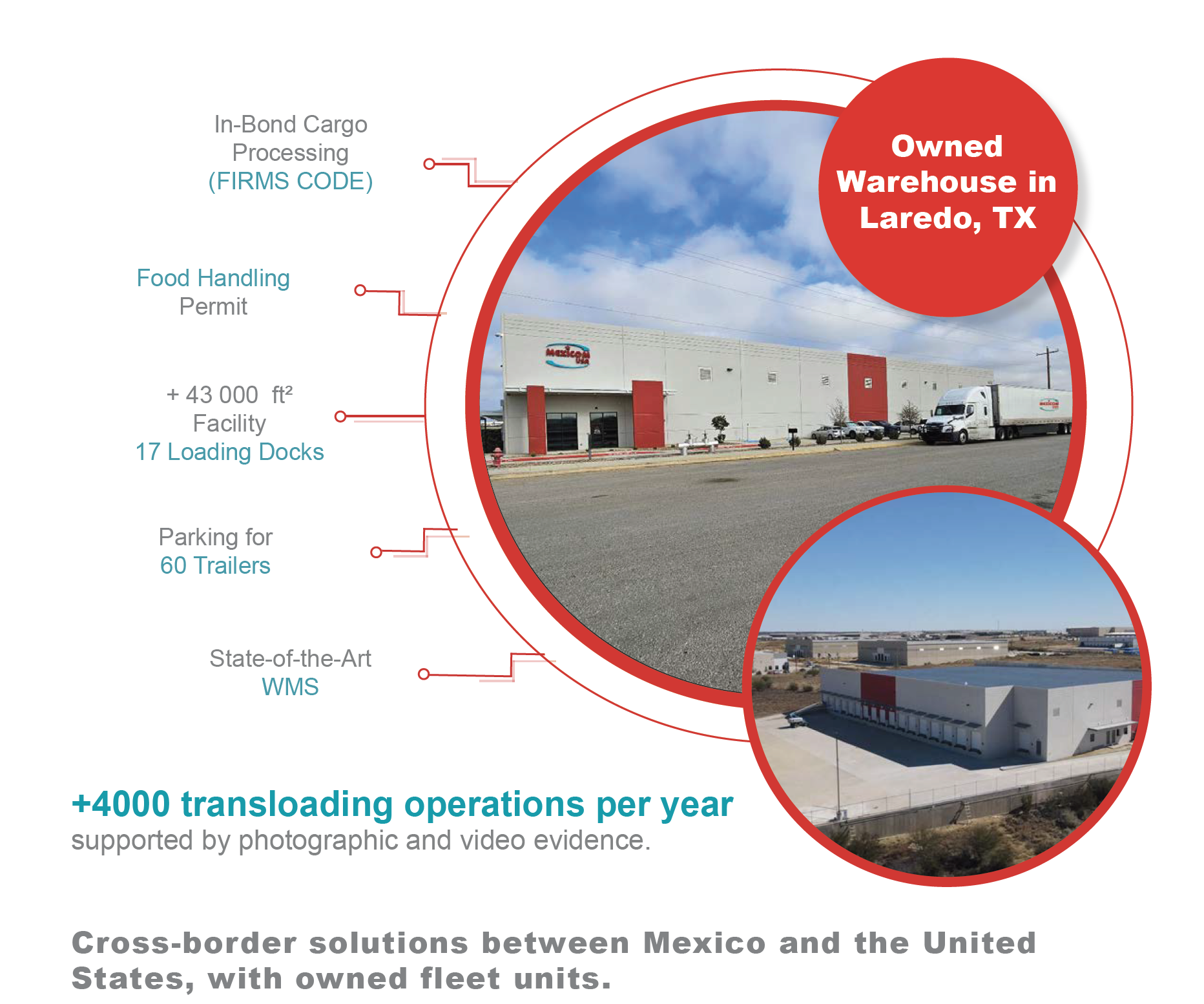
Strategically located in Laredo, our warehouse keeps your cross-border freight moving.
Contact us today
info@mexicomusa.com
Tel. +1 (956) 516-7201